Steel plate MOQ (Minimum Order Quantity) is one of the most important factors affecting your price per ton, sourcing strategy, and project feasibility.
In practical terms, steel plate MOQ can range from just 1 plate (stock purchase) to 50 tons or more (mill production orders)—and the difference comes down to how your order is fulfilled.
What Is Steel Plate MOQ?
Steel plate MOQ refers to the minimum quantity a supplier requires per order.
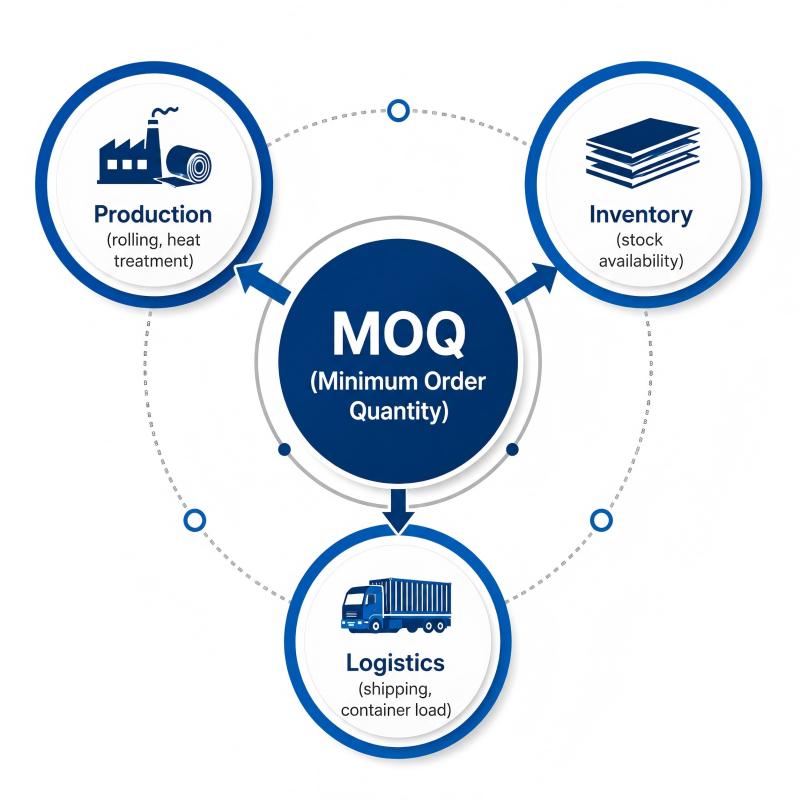
However, in the steel industry, MOQ is not just a sales policy—it is driven by manufacturing constraints, inventory availability, and logistics economics.
👉 The most important distinction:
Stock plates (warehouse inventory): MOQ can be as low as 1 plate
Mill production (new rolling): MOQ typically 10–50 tons per specification
Key takeaway:
Your MOQ is determined by whether your order can be fulfilled from stock—or requires new production.
Typical MOQ for Different Steel Plate Types
MOQ varies significantly depending on grade, application, and availability.
Steel Plate Category
Stock MOQ
Mill MOQ
Why MOQ Differs
Carbon Steel (ASTM A36, S235JR, SS400)
1 plate
10–25 tons
Standard grades widely stocked; custom sizes require batch rolling
Pressure Vessel (ASTM A516 Gr 70, P355GH)
1–5 tons
25–50 tons
Requires strict testing (e.g., impact tests, chemical control)
How to Reduce Steel Plate MOQ (Practical Strategies)
If your required quantity is below mill MOQ, use these proven approaches:
1. Use Standard Sizes
Instead of:
11.8 mm → use 12 mm
Custom width → use standard widths
👉 This allows you to buy from stock (even 1 plate)
2. Choose Equivalent Steel Grades
Switch to widely available grades when possible:
ASTM A36
S235JR
SS400
👉 Avoid triggering mill production MOQ
Common grades usually have lower MOQ due to higher availability and stock levels in mills or warehouses. For example, widely used structural steels such as ASTM A36 are often easier to source in smaller quantities compared to specialized grades.
If you’re not familiar with its specifications, this guide on ASTM A36 steel plate equivalent guide can help you better understand why it is commonly available.
3. Buy from Stockholders Instead of Mills
Mills → large-scale production
Stockholders → bulk-break inventory
👉 They allow:
Small quantities
Faster delivery
Flexible MOQ
4. Consolidate Your Order
If you need multiple specs:
Combine them into one shipment
Reach container load weight (25–28 tons)
👉 Helps reduce unit cost significantly
MOQ vs Price: Understanding the Trade-Off
MOQ and price are strongly linked:
1–5 tons (stock purchase): highest price
20–30 tons (container load): optimized price
100+ tons (mill direct): lowest price
In real projects, increasing your order volume from 5 tons to 25 tons can reduce price per ton by approximately 15%–25%.
Larger orders usually reduce the per-ton price due to economies of scale, but the relationship is not always linear. Factors such as thickness, grade, and standards can significantly influence the final quotation. If you want to understand how these variables affect pricing in detail, this guide on carbon steel plate price per ton, including thickness, grade, and standards provides a comprehensive explanation.
FAQ: Steel Plate MOQ
What is the typical MOQ for steel plates?
Stock purchase: 1 plate or 1 ton
Mill production:
Carbon steel: 10–25 tons
Alloy / pressure vessel steel: 25–50 tons
Can I buy below MOQ?
Yes—but only through:
Stock suppliers
Traders
👉 Expect higher per-ton pricing
Do all suppliers have MOQ?
Yes:
Mills → strict MOQ
Stockholders → flexible MOQ
How to negotiate lower MOQ?
Use standard sizes
Accept equivalent grades
Combine multiple items
Target container load weight
Final Thoughts
Steel plate MOQ is not just a purchasing limit—it reflects how steel is manufactured, tested, and shipped.
To optimize your sourcing:
Align your design with standard market sizes
Prioritize stock availability whenever possible
Consolidate orders to reach efficient shipping volumes
If you’re still evaluating materials, specifications, or sourcing strategy, building a solid understanding of steel grades, logistics terms, and cost structures will significantly improve your procurement efficiency.
Need Flexible Steel Plate Supply?
We support contractors, distributors, and project buyers with:
ASTM / EN / JIS certified steel plates
Stock inventory + mill production options
Custom cutting and processing
Fast global FOB / CIF quotations
👉 Share your grade, thickness, and quantity, and get a quote within 24 hours.
Detailed comparison for O1 vs A2 tool steel for knives and tooling in their properties. Find the right O1 or A2 steel supplier with global delivery service.
See S235, S275 and S355 steel properties, including yield strength, tensile strength, chemical composition and equivalent grades in ASTM, JIS and GB standards.
 CJM Steel Group Ltd.

HelloPlease log in