S235 vs S275 vs S355 Steel Grade Comparison at a Glance
Feature
S235
S275
S355
Yield Strength
235 MPa
275 MPa
355 MPa
Market Position
Budget
Balanced
Premium
Relative Cost
$ (Lowest)
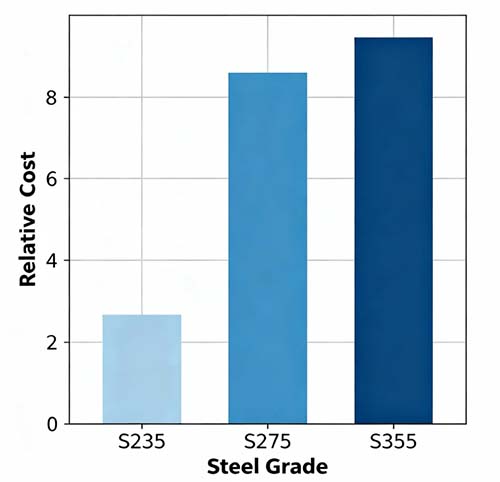
$$ (+10–12%)
$$$ (+20–25%)
Availability
Excellent (common stock)
Very Good (stocked)
Good (some sizes need rolling)
Best For
Low-load, cost-driven projects
General construction, high demand
Heavy construction, project-based sourcing
Introduction
If you’re a steel distributor, trader, or contractor, choosing the right structural steel grade is critical for balancing cost, performance, and profitability. The choice between S235 vs S275 vs S355 steel (from the EN 10025 standard) is one you’ll face often.
While the main difference is in yield strength (235, 275, and 355 MPa), the best grade for your project isn’t just about numbers. It depends on application, budget, and availability in the market.
This guide provides a clear, practical comparison of S235 vs S275 vs S355 steel, helping you make smarter and more profitable purchasing decisions.
Key Considerations Before You Buy
Budget vs. Performance: Lower grades like S235 steel cost less, while S355 steel offers higher strength. Avoid overspending for unnecessary strength or under-specifying and risking safety.
End-Use Application: The steel choice depends on what is being built: a warehouse (low load), a bridge (medium load), or a high-rise (heavy load).
Availability & Supply: S235 vs S275 steel are usually stocked in common sizes, while S355 steel—especially thicker plates or special subgrades like S355J2 or S355NL—may require rolling lead times.
Bar chart comparing the relative cost of S235 S275 and S355 structural steel grades
When to Choose S235 Steel (The Cost-Effective Choice)
S235 steel is the most economical option. It’s widely available and ideal for applications where budget is a key factor and strength requirements are moderate.
Typical Applications:
Residential housing frames and low-rise buildings
Light steel warehouses and storage facilities
Fences, guardrails, and gates
Equipment housings and enclosures
Why S235 Works for Buyers:
Lowest Cost: Typically 10–15% cheaper than S275, and 20–25% cheaper than S355.
Excellent Weldability & Fabrication: Easier to cut, bend, and shape.
Stock Availability: Generally always available in standard sizes.
When to Choose S275 Steel (The Balanced All-Rounder)
S275 steel offers a step up in strength (275 MPa) without a major price increase. It is the versatile choice for a wide range of construction projects.
Typical Applications:
Medium-span bridges and overpasses
Industrial halls and commercial buildings
Transmission towers and pipelines
Railway stations and public facilities
Why S275 is Popular Among Traders:
Balanced Value: Typically around 10–12% more expensive than S235, but often the best compromise between cost and performance.
High Demand: Widely used in Europe, Africa, and the Middle East.
Reliable Inventory: Commonly stocked, with fast supply cycles.
When to Choose S355 Steel (The High-Strength Performer)
S355 steel delivers the highest yield strength (355 MPa). It is specified for heavy-load, high-rise, and demanding environments where safety and durability matter.
Typical Applications:
Skyscrapers and high-rise structures
Heavy-duty bridges and highway flyovers
Offshore oil & gas platforms
Wind towers and industrial equipment
Why S355 Meets Specialized Needs:
High Strength Advantage: Typically 20–25% more expensive than S235, but allows lighter structural sections.
Superior Toughness: Performs better in low temperatures and dynamic loading conditions.
Stocking Note: While S355JR steel plates are often available, thicker plates or grades like S355J2/NL may require mill rolling orders with longer lead times.
Contact ustoday for a competitive quote and current stock availability.
FAQ: S235, S275, and S355 Steel for Buyers & Contractors
Q1: What is the difference between S235, S275, and S355 steel? S235, S275, and S355 steel differ mainly in yield strength: 235 MPa, 275 MPa, and 355 MPa. Higher grades offer better load-bearing performance but come at higher cost.
Q2: Which steel grade is best for general construction? S275 steel is the most common choice for general construction due to its balanced strength, availability, and moderate price.
Q3: When should I choose S355 steel? S355 steel is preferred for heavy-load structures such as bridges, high-rise buildings, and industrial equipment where high strength and durability are required.
Q4: Is S235 steel suitable for budget-sensitive projects? Yes. S235 steel offers the lowest cost and is widely used in low-load applications like warehouses, housing frames, and light structures.
Q5: What is the yield strength difference between S235, S275, and S355 steel? S235 offers around 235 MPa, S275 around 275 MPa, and S355 around 355 MPa. These strength levels mainly affect project load capacity and material selection rather than day-to-day fabrication.
Q6: Which steel grade is more readily available in stock? S235 and S275 are commonly stocked in most markets. S355 may require rolling lead time for thicker plates or special subgrades.
Q7: Are S235, S275, and S355 steel grades easy to weld and fabricate? Yes. All three grades have good weldability, but S235 is generally the easiest to fabricate and process.
Q8: Does choosing S355 reduce structural weight? Yes. Higher strength allows use of smaller or lighter sections while maintaining the same load capacity.
Conclusion
For traders, distributors, and contractors, the right choice depends on balancing cost, strength, and supply availability:
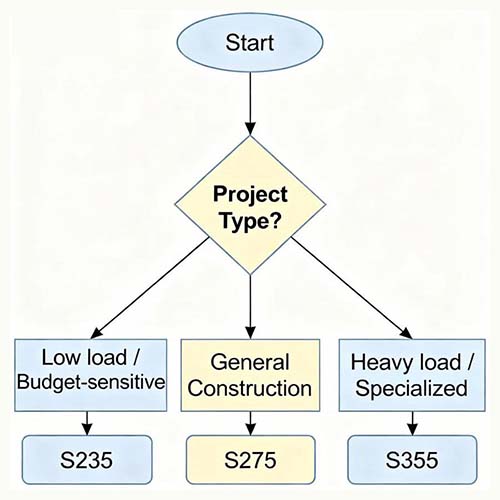
S235 steel → Best for budget-sensitive projects and fast-moving stock.
S275 steel → Reliable all-round grade for general construction.
S355 steel → High-strength solution for specialized, heavy-duty projects.
If you’re sourcing S235, S275, or S355 structural steel, CJM provides a wide range of EN 10025 certified plates and sections, with global export experience and reliable delivery.
Learn the practical differences between hot and cold rolled steel coils. Discover the right choice for your project and how to source quality steel coil from China with CJM.
Explore galvanized wall panels, GI roofing sheets, and steel plates for container houses and modular buildings. Learn how to choose properly for your projects.
Why shooting target manufacturers prefer AR500 steel plate for durability and cost efficiency? Learn how target steel properties make it the standard choice.
Construction machinery such as excavators, bulldozers, and concrete mixers operates in harsh environments where surfaces are exposed to constant wear and impact. One of the most effective ways to extend the service life of these machines is by u...
HelloPlease log in