Q355 is a low-alloy high-strength structural steel defined in GB/T 1591 with a minimum yield strength of 355 MPa. It is widely used in buildings, bridges, machinery, and fabrication.
For global buyers, the key question is:
“What is Q355 equivalent to in EN, ASTM, and JIS standards?”
Below is the commonly accepted international equivalence:
Chinese Standard
Equivalent Standard
Grade
GB/T 1591
EN 10025-2
S355JR / S355JO / S355J2
GB/T 1591
ASTM A572
Grade 50 (based on yield strength)
GB/T 1591
JIS G3106
SS490*
*Note: SS490 comparison is based mainly on tensile properties; confirm yield strength, impact toughness, and specification requirements before substitution.
Q355 Yield Strength and Key Properties
Property
Value
Standard
GB/T 1591
Minimum Yield Strength
≥355 MPa
Tensile Strength
470–630 MPa
Typical Grades
Q355B / Q355C / Q355D / Q355E
Q355 vs S355: Are They Equivalent?
1. Strength Comparison
Property
Q355
S355
Minimum Yield Strength
≥355 MPa
≥355 MPa
Tensile Strength
470–630 MPa
470–630 MPa
Elongation
Similar
Similar
2. Impact Toughness
Grade
Temperature
Requirement
Q355B
+20°C
≥27 J
Q355C
0°C
≥27 J
Q355D
−20°C
≥27 J
Q355E
−40°C
≥27 J
S355JR
+20°C
≥27 J
S355J0
0°C
≥27 J
S355J2
−20°C
≥27 J
S355NL
−50°C
Higher notch toughness
3. Conclusion
Q355 is generally equivalent to S355 in both strength and performance.
Q355B is comparable to S355JR
Q355C is comparable to S355J0
Q355D is comparable to S355J2
Q355E is similar to S355NL in impact test temperature, but note: S355NL is a normalized/normalized rolled steel with stricter requirements on chemical composition for improved weldability compared to the as-rolled or TMCP state of Q355E.
*For most structural applications, Q355 can be considered a functional equivalent to S355 when the correct grade is selected and approved by the project’s design authority.
Below is the chemical composition of Q355 according to GB/T 1591-2018 (for thickness ≤ 16 mm, maximum values unless noted):
Element
Q355B
Q355C
Q355D
Q355E
C
≤0.24%
≤0.22%
≤0.20%
≤0.18%
Si
≤0.55%
≤0.55%
≤0.55%
≤0.55%
Mn
≤1.60%
≤1.60%
≤1.60%
≤1.60%
P
≤0.035%
≤0.035%
≤0.030%
≤0.025%
S
≤0.035%
≤0.035%
≤0.030%
≤0.020%
Nb+V+Ti
≤0.12%
≤0.12%
≤0.12%
≤0.12%
*Values follow GB/T 1591-2018
Mechanical Properties of Q355 Steel
Grade
Yield Strength (MPa)
Tensile Strength (MPa)
Elongation (%)
Impact Temperature
Q355B
≥355
470–630
≥22
20°C
Q355C
≥355
470–630
≥22
0°C
Q355D
≥355
470–630
≥22
−20°C
Q355E
≥355
470–630
≥22
−40°C
*The above are the minimum requirements per GB/T 1591-2018 for rolled sections and plates. Q355E provides enhanced low-temperature toughness, suitable for cold regions, offshore structures, and energy projects.
q355 steel applications
How to Select Q355B/C/D/E
Application Scenario
Recommended Grade
General construction
Q355B
Welding-focused structures
Q355C
Outdoor / cold regions
Q355D
Extremely low temperature
Q355E
Key Differences
E-grade used in low-temperature engineering & critical welded structures
B → E indicates improved impact toughness
The letter defines the temperature for Charpy V-notch impact test
Composition is similar; toughness and service temperature differ
Can Q355 Replace S355 or ASTM Steel in Engineering Projects?
Yes—Q355 steel can replace S355 and A572 Gr.50 in many applications such as:
Industrial buildings
Prefabricated steel structures
Heavy machinery components
Platforms and support frames
However, the substitution is not automatic. It requires:
Documentation Review: Ensuring the Mill Test Certificate (MTC) for the supplied Q355 meets all specified chemical and mechanical properties.
Design Approval: The responsible engineer must approve the material change based on the project’s governing codes.
Grade-to-Grade Matching: Selecting the correct Q355 grade (B, C, D, E) to match the required impact toughness of the original specification.
Conclusion: Confirming the Right Q355 Equivalent Material
To summarize:
The closest European EN equivalent to Q355 is the S355 series.
A commonly referenced ASTM equivalent is A572 Grade 50.
Always match the impact toughness grade (B, C, D, E) to your project’s service temperature and design requirements.
Technical documentation such as Mill Test Certificates (MTC) with full chemical and mechanical test reports are essential for verification.
Now that the equivalence is clear, the next step is selecting the right product form. To ensure structural safety, selecting the appropriate Q355 grade is critical. Ready to proceed? Choose the product that matches your project’s needs:
Frequently Asked Questions About Q355 Steel Equivalent
Q1. What is Q355 steel equivalent to? Q355 steel is generally considered equivalent to the EN S355 structural steel series in terms of yield strength and mechanical performance. The closest European equivalents are S355JR, S355J0, and S355J2, depending on impact test temperature requirements. In ASTM standards, Q355 is commonly compared to ASTM A572 Grade 50 based on minimum yield strength.
Q2. What is the yield strength of Q355 steel? Q355 structural steel has a minimum yield strength of 355 MPa, according to GB/T 1591.
Q3. What is Q355 steel used for? Common applications include structural steel buildings, bridges, machinery structures, heavy equipment frames, and welded fabrication.
Q4. Is Q355 the same as S355? Q355 and S355 are not identical standards, but they are functionally equivalent for most structural applications. Both have a minimum yield strength of 355 MPa and similar tensile strength ranges. The main differences lie in standard specifications, chemical composition limits, and delivery conditions. Grade matching, such as Q355B vs S355JR, is essential for correct substitution.
Q5. What is the ASTM equivalent of Q355 steel? The most commonly referenced ASTM equivalent of Q355 steel is ASTM A572 Grade 50. This comparison is based primarily on yield strength. However, impact toughness, chemical composition, and specification requirements should always be reviewed before making a direct substitution.
Q6. Which Q355 grade matches S355JR? Q355B is generally considered comparable to S355JR. Both grades require Charpy V-notch impact testing at +20°C and share similar mechanical property ranges. For projects requiring lower temperature toughness, Q355C, Q355D, or Q355E should be selected to match S355J0, S355J2, or S355NL respectively.
Q7. Can Q355 replace S355 or ASTM A572 Grade 50? Yes, Q355 steel can replace S355 and ASTM A572 Grade 50 in many structural and fabrication applications. However, substitution should be approved by the project’s design authority and supported by Mill Test Certificates confirming compliance with chemical composition, mechanical properties, and impact toughness requirements.
Compare pressure vessel steel grades and equivalents across ASTM, EN, and GB standards. Find A516, P265GH, Q345R and other PVQ steel grades in one chart.
Compare ASTM A514 grades B, E, H, and Q. Learn key differences in strength, thickness, and applications to select the right A514 steel grade for your project.
Learn about the most used carbon steel plates in construction: Q355, S355, A572, A709, Q460. Ideal for frames, bridges, towers, and industrial structures.
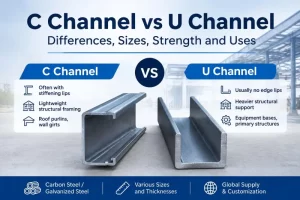
Compare C channel vs U channel steel in differences, sizes, strength, and applications. Learn the key differences and how to choose wisely for your project.
 CJM Steel Group Ltd.



HelloPlease log in