The carbon steel plate price per ton is one of the most important factors for buyers sourcing steel globally. However, there is no fixed number, because carbon steel price, carbon steel cost, and overall steel plate pricing depend on thickness, grade, size, and processing requirements.
In real purchasing scenarios, buyers are not only comparing steel plate price per ton, but also evaluating the total cost of carbon steel, including cutting, dimensions, and delivery conditions.
Understanding these key cost drivers helps you estimate carbon steel prices more accurately and avoid unrealistic quotations.
What Affects Carbon Steel Plate Price the Most?
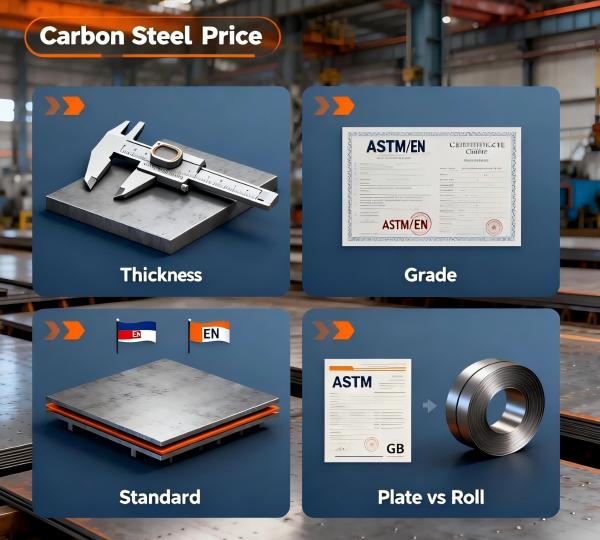
Key factors influencing steel plate price including thickness grade and supply form
The main factors affecting carbon steel plate price per ton are summarized below:
Factor
Impact Level
Why It Matters
Thickness
★★★
Affects rolling difficulty and mill capability
Steel Grade
★★☆
Higher strength requires stricter composition control
Plate vs Coil
★★★
Processing cost included in plate
Size & Dimensions
★★☆
Non-standard sizes increase cost
Certification
★★
Testing and inspection add cost
These factors explain why carbon steel prices and steel plate costs vary significantly across different orders.
Thickness vs Price: The Biggest Cost Driver
Thickness is the most important factor affecting carbon steel plate price per ton.
1. Typical Price Impact by Thickness
(Based on 10–20 mm A36 carbon steel plate as the baseline)
10–20 mm → base carbon steel price per ton
20–40 mm → typically +10–25% higher
40 mm+ → can be +30–60% higher
The exact increase depends on mill capability, order volume, and steel grade.
2. Why Thickness Increases Cost
Higher rolling difficulty
Increased energy consumption
Lower production efficiency
For plates above 40 mm, only a limited number of mills can produce them, and yield rates are lower. This is why heavy plates often carry a significant premium in carbon steel pricing.
3. Thickness and Application
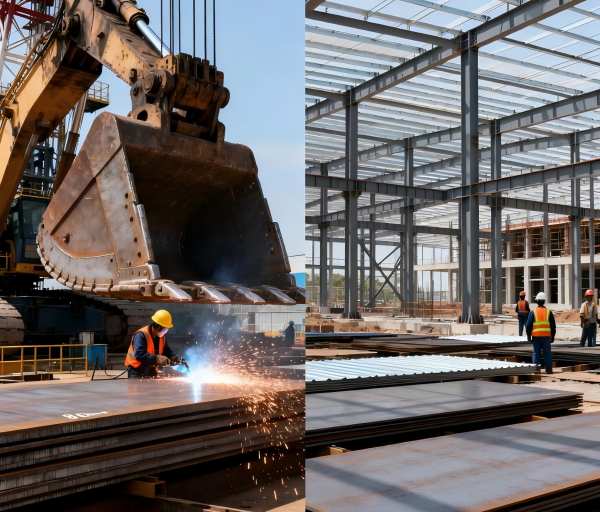
10–40 mm → construction, fabrication, general structures
40 mm+ → heavy machinery, offshore structures, high-load applications
This is why buyers find carbon steel price per ton differs depending on thickness.
Steel grade directly impacts both performance and carbon steel plate price.
Practical Price Difference by Grade Level
Mild steel → lower carbon steel price, widely used
High strength steel → higher steel plate price
Higher-strength steels require stricter chemical composition control and more advanced production processes, increasing the overall cost of carbon steel.
Instead of relying on a fixed number, experienced buyers evaluate carbon stee l plate price per ton by comparing quotations against known cost patterns.
How to Judge if a Price is Reasonable
Compare thickness: thicker plates should show a clear price increase
Compare grade: higher strength steel should cost more
Compare form: plate prices should be higher than coil
If a quotation does not follow these patterns, it may indicate:
Incorrect specifications
Missing processing costs
Or unrealistic pricing
This method helps buyers quickly evaluate carbon steel cost without relying on outdated or misleading price references.
What Buyers Should Provide for Accurate Pricing
To receive an accurate quotation, provide:
Steel grade
Thickness
Plate size (length × width)
Quantity
Processing requirements
Clear specifications help suppliers calculate carbon steel prices more accurately and avoid delays.
Get an Accurate Carbon Steel Plate Price
If you are sourcing steel plates and need a reliable carbon steel plate price per ton, the fastest way is to request a quotation based on your exact specifications.
Accurate pricing based on current market conditions
Processing and cutting options
FAQ: Carbon Steel Pricing
What is the carbon steel price per ton? The carbon steel price per ton depends on thickness, grade, and processing. There is no fixed price because specifications determine cost.
What is carbon steel price per kg or per pound? Carbon steel prices can be converted into per kg or per pound, but total cost still depends on specifications such as thickness and grade.
Why does carbon steel cost vary so much? Because carbon steel cost is influenced by thickness, grade, size, processing, and market supply conditions.
How much does a steel plate cost? Steel plate cost varies depending on specifications. Buyers should evaluate thickness, grade, and processing instead of expecting a fixed number.
Is steel plate more expensive than coil? Yes. Steel plate pricing is usually higher because of additional processing or different production methods.
Learn the practical differences between hot and cold rolled steel coils. Discover the right choice for your project and how to source quality steel coil from China with CJM.
Carbon steel wire is a widely used material in various industries due to its strength, durability, and cost-effectiveness. It is commonly found in applications ranging from automotive to construction, offering an excellent balance of performance a...
 CJM Steel Group Ltd.

HelloPlease log in