ASTM A36 vs SS400 is one of the most common comparisons in global structural steel sourcing and engineering design. A common question in structural steel sourcing is: Is SS400 equivalent to ASTM A36, and can it replace A36 in engineering projects?
While ASTM A36 and JIS SS400 are both widely used mild structural steels, they are defined under different standards and do not behave identically in terms of certification, yield strength, and engineering reliability.
This guide provides a detailed comparison of ASTM A36 vs SS400, focusing on:
Whether SS400 is equivalent to ASTM A36
Key differences in yield strength and standards
When SS400 can (and cannot) replace A36
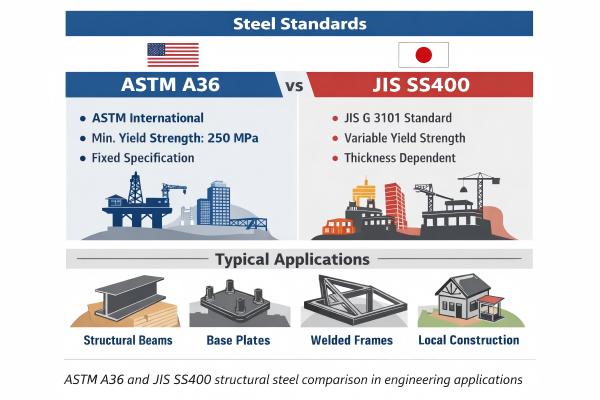
ASTM A36 and JIS SS400 structural steel comparison in engineering applications
Quick Answer: Is SS400 Equivalent to ASTM A36?
Short answer: No — SS400 is not officially equivalent to ASTM A36.
However:
SS400 is often considered a practical alternative in non-critical applications
There is no direct ASTM equivalent defined for SS400
Substitution depends on engineering approval and project requirements
ASTM A36 vs SS400: Key Differences
Understanding the standard systems behind A36 vs SS400 is essential for accurate material selection.
Property
ASTM A36
JIS SS400
Standard
ASTM International
JIS G 3101
Yield Strength
≥ 250 MPa (guaranteed)
Not specified
Tensile Strength
400–550 MPa
400–510 MPa
Certification
Strict ASTM MTC
Varies by mill
Consistency
High
Variable
Typical Use
International projects
Asian markets
Key Insight: The biggest difference is not chemistry — it’s whether yield strength is guaranteed.
For projects involving European standards, a detailed comparison can be found in our guide on ASTM A36 vs EN S235JR, which explains differences in strength, standard systems, and application scenarios.
ASTM A36 vs SS400 Yield Strength Difference
When comparing ASTM A36 vs SS400, yield strength is the most critical parameter.
ASTM A36
Minimum yield strength: 250 MPa (36 ksi) for thickness up to 200 mm
Tensile strength: 400–550 MPa
SS400
Yield strength: not specified in JIS G 3101
Common mill practice:
≤ 16 mm: approximately 245 MPa
16–40 mm: approximately 235 MPa
40 mm: may be lower depending on rolling practice
Tensile strength: 400–510 MPa
The key a36 vs ss400 difference is that ASTM A36 guarantees a minimum yield strength, while SS400 relies on typical production values.
Why Standards Matter More Than Strength
Many buyers focus only on strength values, but the real difference lies in standard philosophy:
ASTM A36
Defines minimum mechanical guarantees
Supports inspection and certification
Suitable for international EPC and export projects
SS400
Based on typical production capability
Allows wider variation
Relies heavily on mill test reports
👉 This is why A36 vs SS400 is fundamentally a compliance issue, not just a strength comparison.
Is SS400 Equivalent to ASTM A36?
No.
There is no official ASTM equivalent designation.
SS400 is only:
A conditional substitute in practice
A commonly compared material
When Can SS400 Replace ASTM A36?
SS400 may be used as a substitute if:
The project does not strictly require ASTM standards
Mechanical properties are verified by MTC
Engineering approval is obtained
Application is non-critical
When SS400 Should NOT Replace ASTM A36
Avoid substitution when:
ASTM standard is specified in contract
Third-party inspection is required
Project follows international or U.S. codes
Structural reliability must be guaranteed
Potential Risks
Lower yield strength in thick sections
Inspection rejection
Compliance failure
Rework and project delays
Applications of ASTM A36 and SS400
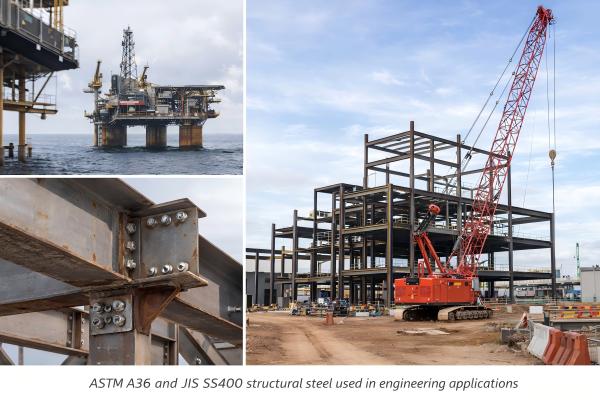
ASTM A36 and JIS SS400 structural steel used in construction and industrial fabrication projects
Both ASTM A36 and SS400 are widely used in:
Structural beams and columns
Base plates and brackets
Welded frames and supports
General fabrication and machining
From a usage perspective:
SS400 is more common in local construction projects under JIS standards
ASTM A36 is more widely used in international and export-oriented engineering
Both materials offer good weldability due to low carbon content, making them suitable for general structural fabrication.
Can SS400 Fully Replace A36?
The question of substitution is central to astm a36 vs ss400 discussions.
No — not in a strict engineering sense.
SS400 should be treated as:
A comparable material
A conditional substitute
Not a guaranteed replacement
You can refer to our comparison of ASTM A36 vs Q235B to understand equivalency considerations, performance differences, and potential project risks when substituting materials across standards.
Conclusion
The difference between A36 and SS400 is primarily defined by:
Yield strength definition
Thickness sensitivity
Standard enforcement philosophy
Final takeaway:
Use ASTM A36 when compliance and consistency are required
Use SS400 only when conditions allow flexibility
For any project, material selection should be based on certified data and engineering approval, not on nominal similarity.
FAQs
Q1: Is SS400 equivalent to ASTM A36? A: No. SS400 is not officially equivalent, but may be used as a practical alternative in some cases.
Q2: What is the difference between ASTM A36 and SS400? A: The main difference between A36 and SS400 is that ASTM A36 defines a minimum yield strength, while SS400 does not.
Q3: Can SS400 replace ASTM A36? A: SS400 can be used in limited cases if mechanical properties are verified and approved by engineers.
Q4: Why is SS400 yield strength not fixed? A: Because the JIS standard relies on manufacturing practice rather than fixed minimum requirements.
Q5: Which is better for export projects? ASTM A36 is preferred due to certification and compliance reliability.
A practical carbon steel material guide covering global standard, grades, properties, sizes and weight calculation tools for structural and industrial projects.
Why shooting target manufacturers prefer AR500 steel plate for durability and cost efficiency? Learn how target steel properties make it the standard choice.
Compare A516, A537 and P355GH steel plates for oil & gas storage tanks. Learn pressure, temperature limits, and how to choose the right tank plate material.
 CJM Steel Group Ltd.



HelloPlease log in