 CJM Steel Group Ltd.

Structural Steel Grades, Properties & Standards Guide
4106Learn common structural steel grades, material properties, chemical composition, yield strength, tensile strength, and major ASTM and international standards.
View detailsSearch the whole station
Galvanized steel sheets are widely used in construction, automotive, and industrial applications due to their corrosion resistance and stable mechanical performance.
Typical galvanized steel properties are:
These values depend primarily on the base steel grade (such as DX51D, SGCC, or S350GD), while the zinc coating provides corrosion protection without significantly affecting strength.
This guide explains galvanized steel mechanical properties, coating specifications, and international standards to support engineering selection and global sourcing.
Quick Navigation
The galvanized steel mechanical properties are primarily determined by the base steel grade, while the zinc coating provides corrosion resistance.
Key properties of galvanized steel include yield strength, tensile strength, elongation, and hardness.
The yield strength of galvanized steel typically ranges from 140 MPa to over 550 MPa, depending on the grade.
| Grade | Yield Strength (MPa) |
|---|---|
| DX51D+Z | ≥140 |
| SGCC | ≥205 |
| S350GD+Z | ≥350 |
Higher yield strength grades are used in structural and load-bearing applications.
The tensile strength of galvanized steel generally falls between 270 MPa and 600 MPa.
This ensures resistance to deformation under load and is critical in applications such as roofing systems, structural panels, and automotive components.
The hardness of galvanized steel is determined by the base material rather than the zinc coating.
Typical hardness values:
The zinc layer is relatively soft, which helps reduce tool wear during cutting and forming.
Galvanized steel sheets offer elongation values between 18% and 25% for forming grades such as DX51D and SGCC.
This allows bending, roll forming, and deep drawing without cracking.
In this process, steel sheets or coils are immersed in molten zinc at approximately 450°C, forming a metallurgical bond between the zinc and the base metal. The resulting zinc-iron alloy layers provide excellent adhesion and wear resistance, making this method ideal for structural and outdoor applications.
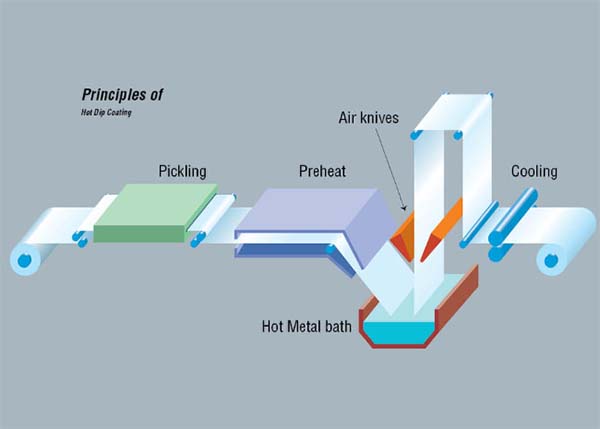
This technique uses electrical current to deposit a thin layer of zinc onto the steel surface. It results in more uniform and aesthetically pleasing coatings, though with less corrosion resistance compared to HDG. Electro-galvanized steel is often used in electronics and automotive inner panels.
Most galvanized sheet products are produced using continuous lines that combine rolling, annealing, cleaning, and galvanizing in a single integrated process. This ensures consistency in coating thickness, surface finish, and dimensional control.
Galvanized steel is typically processed and supplied in the following formats:
| Form | Thickness Range (mm) | Width Range (mm) | Description |
|---|---|---|---|
| Galvanized Steel Sheet | 0.30 – 3.00 | 600 – 1500 | Flat panels used in construction and enclosures |
| Galvanized Steel Coil | 0.30 – 3.00 | 600 – 1500 | Coiled form, suitable for slitting or roll forming |
| Galvanized Steel Plate | 3.00 – 25.00 | 1000 – 2500 | Heavy-duty material for structural applications |
Sheets are favored in roofing, siding, and interior fabrication, while coils allow for easy transport and processing. Plates are used in structural members, bridge decks, and machinery supports.
Several global standards govern the quality and performance of galvanized steel. Commonly referenced specifications include:
| Standard | Country/Region | Common Grades | Applications |
|---|---|---|---|
| ASTM A653 | USA | CS Type A/B, SS Grade 33–80 | General & structural steel work |
| JIS G3302 | Japan | SGCC, SGCD, SGCE | Deep drawing, forming, bending |
| EN 10346 | Europe | DX51D+Z, S220GD–S550GD | Structural steel, roofing systems |
| IS 277 | India | Designations by coating mass | Utility and general fabrication |
Grades differ in mechanical strength, ductility, and coating weight. Coating designations such as Z100 or Z275 refer to the total zinc mass per square meter.
The performance of galvanized steel is directly influenced by the weight and consistency of its zinc coating. Typical coating levels include:
| Coating Grade | Zinc Mass (g/m²) | Use Case |
|---|---|---|
| Z60 | 60 | Indoor structures, short-life components |
| Z120 | 120 | Automotive, residential roofing |
| Z275 | 275 | High-corrosion zones, coastal buildings |
The galvanized steel sheet price is influenced heavily by the coating weight and base steel grade. Thicker coatings provide better durability but may affect weldability and forming properties.
Galvanized steel is integral to multiple industries due to its adaptability and longevity:
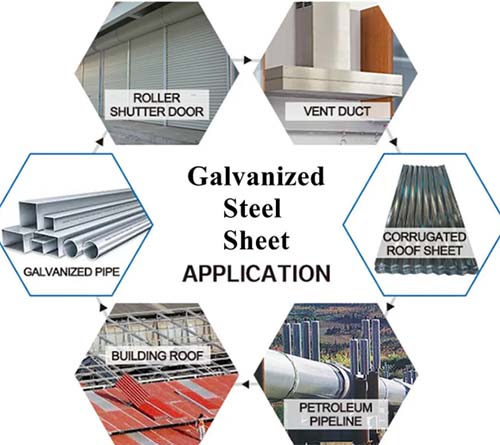
Its resistance to weathering makes it suitable for both commercial and residential buildings.
For applications requiring enhanced slip resistance, such as walkways, stair treads, and industrial platforms, hot-dip galvanized checkered plates are often selected to combine corrosion protection with improved surface safety.
Galvanized components reduce rust-related repairs and extend vehicle service life.
The conductive and protective properties of zinc coatings enhance the safety and reliability of such components.
Coated steel prevents rust under high-humidity or manure exposure.
Galvanized steel sheets may be processed further to improve aesthetic or functional characteristics:
Buyers can request surface customization based on intended application or regulatory compliance (e.g., RoHS).
Reliable suppliers provide thorough testing and quality documentation:
| Test/Parameter | Purpose |
|---|---|
| Coating Thickness Test | Confirms zinc mass uniformity |
| Adhesion Test (peel or bend) | Evaluates bonding between coating and base |
| Salt Spray Test (ASTM B117) | Assesses corrosion resistance |
| Mechanical Properties (UTM) | Confirms tensile and yield performance |
| Dimensional Tolerances | Ensures width, length, flatness accuracy |
Certificates such as Mill Test Reports (MTRs), SGS or BV inspections may be required for customs or third-party verification.
Large volume orders can be shipped via bulk vessel or break bulk, particularly for heavy plates or oversized coils.
| Factor | Description |
|---|---|
| Production Capacity | Line width, annual output (important for large orders) |
| Certifications | ISO 9001, CE, SGS, BIS, or UL, depending on region |
| Customization | Coating weight, cut-to-length, packaging type |
| Export Experience | Countries served, documentation support |
| Response Time | Ability to quote quickly and ship fast |
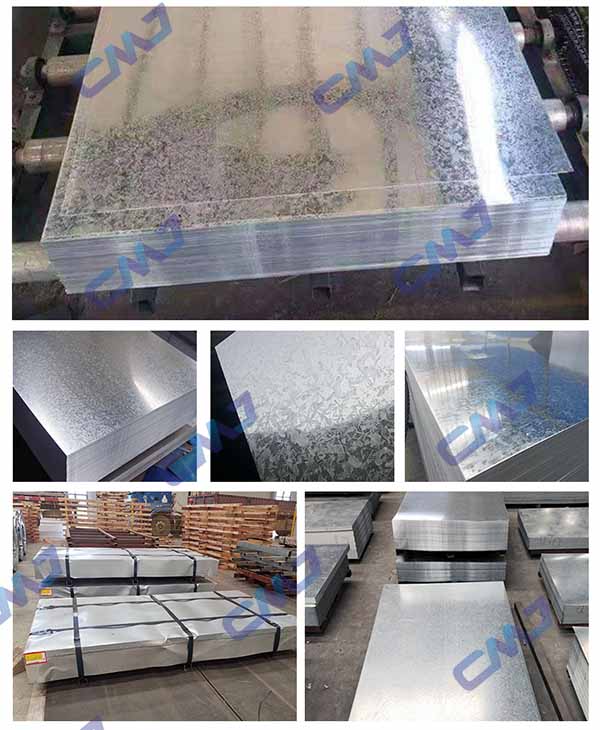
CJM is an experienced exporter of galvanized steel sheet and coil, offering:
CJM maintains long-term partnerships with fabricators, traders, and project contractors across Asia, the Middle East, Africa, Europe and America.
Galvanized steel offers a balance of mechanical strength and corrosion resistance, making it suitable for construction, fabrication, and industrial applications.
Understanding the galvanized steel properties, coating specifications, and grade selection helps buyers choose the right material for long-term performance.
For technical datasheets, or consultation on galvanized steel solutions, reach out to CJM’s professional export team.
Email: info@cjmstainlesssteel.com
WhatsApp: +86 18191906640
Learn common structural steel grades, material properties, chemical composition, yield strength, tensile strength, and major ASTM and international standards.
View details
Complete H beam size chart and weight table in mm for structural design. Covers EN, JIS, and ASTM standards used in global construction projects.
View details
Compare HSLA steel grades, properties, and strength levels. View grade charts and learn how HSLA steel plate is used in structural and industrial projects.
View details
Steel plate price is affected by freight, MOQ, and standards. Learn how international buyers calculate real procurement cost and optimize sourcing decisions.
View details
HelloPlease log in