 CJM Steel Group Ltd.

Steel Round Bar Sizes, Dimensions and Weight
1274Explore steel round bar sizes, dimensions, and weight charts in metric and inch sizes. Learn round bar weight per foot, kg/m, and calculation formulas.
View detailsSearch the whole station
Steel round bar grades define the chemical composition, mechanical properties, heat treatment requirements, and typical applications of round steel bars. Choosing the right grade depends on factors such as strength, machinability, hardness, wear resistance, corrosion requirements, and the applicable material standard.
For buyers, understanding the main steel round bar grades helps narrow down suitable materials before comparing dimensions, heat treatment, certification, and supplier capabilities.
A steel round bar grade identifies a specific steel composition and property range defined by a material standard or specification.
Depending on the grade, steel round bars can differ significantly in:
The same diameter of round bar can therefore have very different performance depending on its grade.
For procurement, the grade should normally be selected together with the material standard, diameter, length, delivery condition, and required mechanical properties.
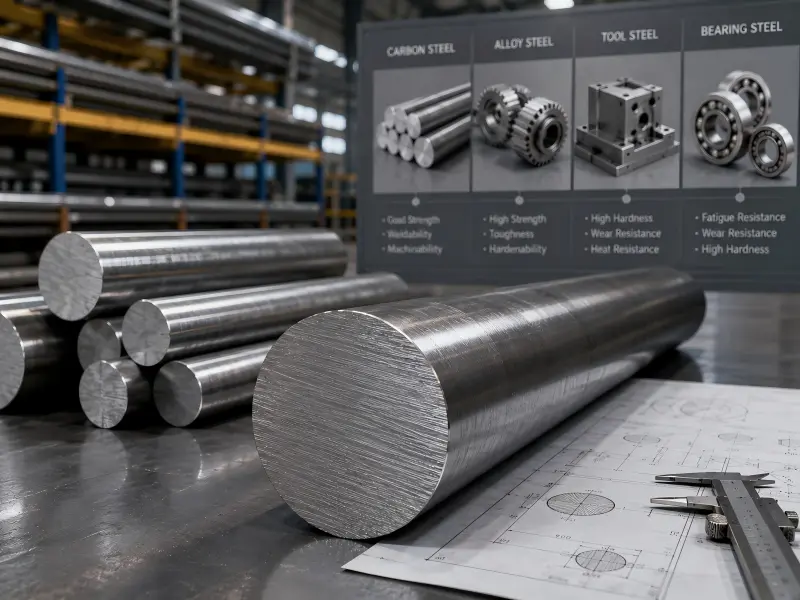
Carbon steel round bars are widely used for general fabrication, machining, construction, shafts, pins, and other mechanical components.
Common grades include low-carbon, medium-carbon, and free-machining steels.
| Grade | Type | Main Characteristics | Typical Applications |
|---|---|---|---|
| 1018 | Low-carbon steel | Good machinability and weldability | Shafts, pins, general machining |
| 1020 | Low-carbon steel | Good combination of strength, ductility, and machinability | Machine parts, shafts, general fabrication |
| 1045 | Medium-carbon steel | Higher strength and hardness than low-carbon grades | Shafts, gears, axles, machinery components |
| A36 | Carbon structural steel | Good weldability and general structural performance | Structural components, fabrication, machinery |
| 1144 | Free-machining steel | Improved machinability and good strength | Precision-machined components |
The best grade depends on the component requirements rather than simply selecting the grade with the highest strength.
For example, a component requiring extensive machining may benefit from a free-machining grade, while a shaft exposed to higher mechanical loads may require a medium-carbon or alloy steel grade.
Alloy steel round bars contain additional alloying elements such as chromium, molybdenum, nickel, or manganese to improve mechanical performance and heat-treatment response.
| Grade | General Type | Main Characteristics | Typical Applications |
|---|---|---|---|
| 4130 | Cr-Mo alloy steel | Good strength-to-weight ratio and toughness | Machinery, structural components |
| 4140 | Cr-Mo alloy steel | High strength, hardness, and wear resistance | Shafts, gears, bolts, machine parts |
| 4340 | Ni-Cr-Mo alloy steel | High strength and toughness | Heavy-duty machinery, gears, shafts |
| Other alloy grades | Various alloy systems | Properties vary according to composition and treatment | Engineering and industrial components |
Alloy steel grades are often selected when standard carbon steel does not provide sufficient strength, toughness, hardness, or fatigue resistance.
Heat treatment is also important. The final properties of an alloy steel round bar can vary considerably depending on whether it is supplied annealed, normalized, quenched and tempered, or in another specified condition.
Not all round bars are selected primarily for general structural or machining applications. Some grades are designed for specific performance requirements.
| Grade Type | Main Purpose | Typical Applications |
|---|---|---|
| Tool steel | High hardness and wear resistance | Dies, cutting tools, molds |
| Bearing steel | High fatigue and wear resistance | Bearings and high-load components |
| Spring steel | High elasticity and fatigue resistance | Springs and resilient components |
| Hardened steel | Increased hardness and wear resistance | Wear-resistant mechanical components |
These materials should be specified according to the actual operating conditions of the component.
For example, tool steel round bar is normally selected when hardness and wear resistance are more important than general fabrication properties, while bearing steel is designed for repeated contact and fatigue loading.
Choosing the right grade is more important than simply selecting a commonly used material. Buyers should start with the actual service requirements of the component.
Determine whether the round bar needs to withstand:
If higher strength is required, medium-carbon or alloy steel grades may be more appropriate than low-carbon steel.
If the round bar will undergo substantial turning, drilling, milling, or other machining operations, machinability becomes an important purchasing factor.
Low-carbon and free-machining grades are often easier to machine, while some high-strength or hardened materials may require more demanding machining conditions.
For components exposed to friction, impact, or repeated contact, hardness and wear resistance may be more important than basic tensile strength.
In these applications, buyers may consider:
For fabricated components, weldability should be considered before selecting a grade.
Low-carbon steel generally provides better weldability, while higher-carbon and alloy steels may require controlled welding procedures or preheating depending on the grade and thickness.
The same steel round bar grade can be supplied in different conditions, including:
Heat treatment can significantly change hardness, strength, toughness, and machinability.
Therefore, a purchase specification should not normally state only the grade. The required delivery condition should also be defined when mechanical properties are critical.
Always verify which standard applies to the project.
A material designation can have different requirements depending on the governing specification. Buyers should confirm the applicable ASTM, AISI, SAE, EN, DIN, JIS, or other standard before placing an order.
For commercial procurement, material availability can also influence grade selection.
If several grades can meet the engineering requirements, buyers may compare:
The most suitable grade is therefore not necessarily the strongest or most expensive option. It is the grade that meets the required performance at an acceptable total procurement cost.
Once the grade and standard have been confirmed, buyers should also specify the required diameter and length. For guidance on available dimensions, metric and inch sizes, and theoretical weight calculations, see our guide to Steel Round Bar Sizes, Dimensions and Weight.
Steel round bar grades are commonly specified under different international material and designation systems.
| Standard / System | Common Use |
|---|---|
| ASTM | Material specifications widely used in international projects |
| AISI | Steel grade designation and classification |
| SAE | Steel grades and chemical composition designations |
| EN | European material and product standards |
| DIN | German standards and material designations |
| JIS | Japanese Industrial Standards |
These systems are not always directly interchangeable.
For example, two grades may have similar chemical compositions but still differ in dimensional requirements, mechanical properties, testing requirements, or certification conditions.
When purchasing round steel bars, it is therefore better to specify the exact grade and applicable standard rather than relying only on an assumed equivalent.
Common grades include low-carbon grades, medium-carbon grades, structural grades, free-machining steels, and alloy steel grades. The appropriate choice depends on the required strength, machinability, hardness, and application.
Carbon steel relies primarily on carbon as the main strengthening element, while alloy steel contains additional alloying elements such as chromium, nickel, molybdenum, or manganese to achieve specific performance characteristics.
Start with the required strength, hardness, toughness, machinability, weldability, heat treatment condition, and applicable material standard. Then compare material availability and cost.
Not necessarily. Even grades with similar compositions may have different mechanical properties, standards, heat-treatment requirements, or certification requirements. Always verify the applicable specification before substitution.
Selecting the right steel round bar grade requires more than comparing grade names. Buyers should consider the required mechanical properties, machinability, hardness, heat treatment, applicable standard, dimensions, availability, and overall procurement requirements.
For general applications, carbon steel grades may provide a practical balance of cost and performance, while alloy, tool, bearing, and spring steels are available for more demanding applications.
CJM Steel supplies a range of Carbon Steel Bar products for different industrial and fabrication requirements, with options for specified grades, dimensions, lengths, and certification requirements.
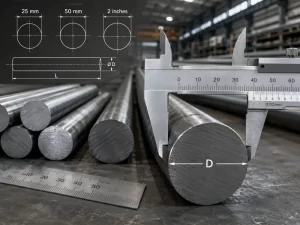
Explore steel round bar sizes, dimensions, and weight charts in metric and inch sizes. Learn round bar weight per foot, kg/m, and calculation formulas.
View details
Learn about galvanized steel thicknesses (11, 12, 14, 16, 18, 20, 24 gauge) and sizes. Get expert advice on choosing the right steel sheet for your project.
View details
Source carbon steel plates from China with this guide covering suppliers, prices, grades, shipping, import costs, and key factors for global buyers.
View details
Discover 4140 steel overview: key specifications, broad applications in automotive, machinery, and energy industries and main features for buyers and engineers.
View details
Learn what affects steel plate cutting cost, including thickness, cutting method, complexity, quantity, and custom cut-to-size requirements.
View details
So,I like it
2026-09-0903:40