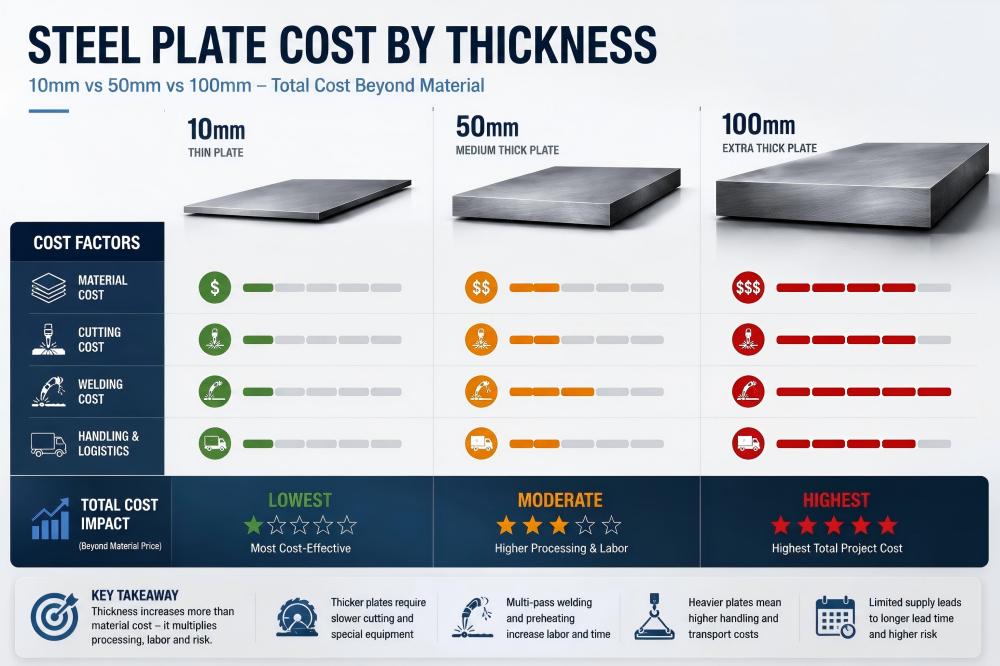
Cost comparison of 10mm 50mm and 100mm steel plates showing how cutting and welding drive total cost beyond material price
10mm vs 50mm vs 100mm: Why Cost Differences Go Beyond Material
At first glance, steel plates of different thicknesses may appear to follow a linear cost pattern. In reality, costs increase non-linearly as thickness grows.
The key difference is not the raw material—but what happens after the plate arrives at your workshop or project site.
10mm Steel Plate
Thin plates are relatively easy to process:
Fast cutting speed
Minimal equipment requirements
Simple welding procedures
Because of this, fabrication costs remain low and predictable.
50mm Steel Plate
At this thickness, the cost structure starts to change:
Cutting requires higher power machines or slower speeds
Edge preparation becomes necessary
Welding often involves multi-pass operations
These additional steps increase both labor time and production cost.
100mm Steel Plate
100mm belongs to extra thick plate category, where cost escalation becomes significant—not because of weight, but because of processing constraints:
Cutting is slow and energy-intensive
Specialized equipment (high-power plasma or flame cutting) is required
Welding requires multi-pass welding and preheating
Distortion control and inspection add extra steps
More importantly, only a limited number of mills globally can reliably produce such thick plates, which directly impacts lead time and supply risk.
The Hidden Cost Drivers Buyers Often Ignore
Most buyers focus on material pricing, but in reality, fabrication and handling costs dominate thick plate projects.
1. Cutting Cost Increases Exponentially
Thin plates → high-speed cutting
Thick plates → slow cutting + higher energy consumption
A 100mm plate can take several times longer to cut than a 10mm plate.
2. Welding Cost Becomes the Major Expense
For thick plates:
Multi-pass welding is required
Preheating is often mandatory
Skilled labor is needed
In many projects, welding cost exceeds material cost difference between thickness options.
3. Handling and Logistics Complexity
Thicker plates mean:
Heavier lifting requirements
Specialized transport
Increased safety measures
This adds indirect cost that is rarely included in initial quotations.
4. Lead Time and Supply Constraints
Unlike standard plates, extra thick plates:
Are not always in stock
Require mill production scheduling
Have longer delivery cycles
This can delay entire projects if not planned properly.
Avoiding Over-Specification: The Biggest Cost Mistake
One of the most common procurement errors is over-specifying thickness for safety margin.
If you are evaluating how thickness affects raw material pricing itself, you can also check our steel plate price per ton guide by grade and thickness.
How to Optimize Steel Plate Thickness for Cost Efficiency
To control total project cost, consider the following strategies:
1. Choose the Minimum Effective Thickness
Avoid using thicker plates unless structurally required.
2. Balance Material vs Fabrication Cost
A slightly thicker plate may reduce welding—but excessive thickness usually increases total cost.
3. Work with Suppliers on Processing Capability
Reliable suppliers can:
Suggest alternative thickness options
Optimize cutting plans
Reduce material waste
4. Consider Design Optimization
In many cases, using:
Reinforcements
Structural redesign
can replace ultra-thick plates entirely.
Final Insight: Thickness Is a Cost Multiplier, Not Just a Specification
Steel plate thickness is not just a number in a drawing.
It is a cost multiplier that affects:
Fabrication complexity
Labor intensity
Delivery timelines
Project risk
Understanding this difference is what separates basic buyers from professional procurement decision-makers.
Need Help Choosing the Right Thickness?
If you’re unsure whether 50mm or 100mm is the right choice for your project, our engineering and sourcing team can help you:
Compare ASTM A514 grades B, E, H, and Q. Learn key differences in strength, thickness, and applications to select the right A514 steel grade for your project.
Complete AISC C channel sizes chart with dimensions, weight (kg/m), and mm conversions. Easy-to-use reference for engineers, fabricators, and steel buyers.
 CJM Steel Group Ltd.



HolaConéctese