 CJM Steel Group Ltd.

42CrMo Equivalent | Material, AISI & Russian Standard Comparison
3643Find 42CrMo equivalent materials including AISI 4140 and Russian GOST grades. Learn differences and choose the right steel pipe for your project.
Ver detallesBuscar en toda la estación
When sourcing steel plates, many buyers assume that thicker plates simply cost more because they weigh more.
However, in real-world procurement, thickness impacts far more than just material cost. It directly affects:
This is why two plates with the same weight but different thicknesses can result in completely different total project costs.
If you are still comparing plates based only on weight or tonnage, you may be underestimating your actual budget.
To understand standard dimensions and conversions before evaluating cost, you can refer to our steel plate thickness chart and size guide.
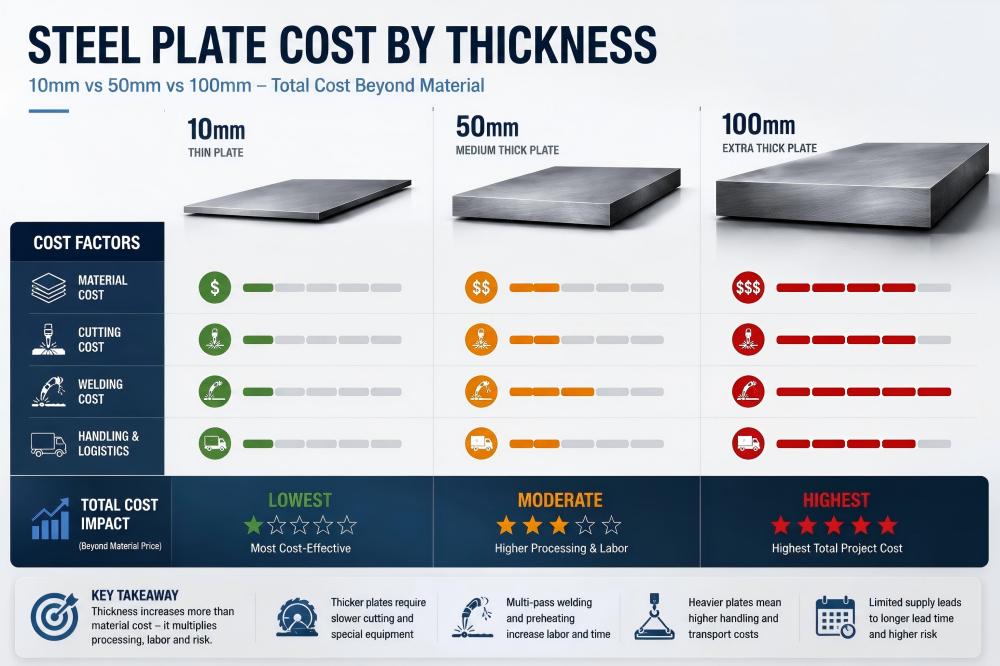
At first glance, steel plates of different thicknesses may appear to follow a linear cost pattern. In reality, costs increase non-linearly as thickness grows.
The key difference is not the raw material—but what happens after the plate arrives at your workshop or project site.
Thin plates are relatively easy to process:
Because of this, fabrication costs remain low and predictable.
At this thickness, the cost structure starts to change:
These additional steps increase both labor time and production cost.
100mm belongs to extra thick plate category, where cost escalation becomes significant—not because of weight, but because of processing constraints:
More importantly, only a limited number of mills globally can reliably produce such thick plates, which directly impacts lead time and supply risk.
Most buyers focus on material pricing, but in reality, fabrication and handling costs dominate thick plate projects.
A 100mm plate can take several times longer to cut than a 10mm plate.
For thick plates:
In many projects, welding cost exceeds material cost difference between thickness options.
Thicker plates mean:
This adds indirect cost that is rarely included in initial quotations.
Unlike standard plates, extra thick plates:
This can delay entire projects if not planned properly.
One of the most common procurement errors is over-specifying thickness for safety margin.
While it may seem safer, it often leads to:
Instead, buyers should focus on:
If you are evaluating how thickness affects raw material pricing itself, you can also check our steel plate price per ton guide by grade and thickness.
To control total project cost, consider the following strategies:
Avoid using thicker plates unless structurally required.
A slightly thicker plate may reduce welding—but excessive thickness usually increases total cost.
Reliable suppliers can:
In many cases, using:
can replace ultra-thick plates entirely.
Steel plate thickness is not just a number in a drawing.
It is a cost multiplier that affects:
Understanding this difference is what separates basic buyers from professional procurement decision-makers.
If you’re unsure whether 50mm or 100mm is the right choice for your project, our engineering and sourcing team can help you:
Póngase en contacto con nosotros today for a tailored steel plate solution.
Find 42CrMo equivalent materials including AISI 4140 and Russian GOST grades. Learn differences and choose the right steel pipe for your project.
Ver detalles
Guía completa sobre la chapa de acero ASTM A514: resistencia, dureza, soldadura, maquinabilidad, composición química y grados equivalentes para sus proyectos.
Ver detalles
Compare S235 vs S275 vs S355 steel in strength, price and applications. Learn the key differences and choose the right steel grade for your project.
Ver detalles
Descubra los grados, tipos y normas mundiales del acero estructural. Compare A36, S235JR, S355, A572, A588 y más. Consejos prácticos para compradores internacionales.
Ver detalles
HolaConéctese