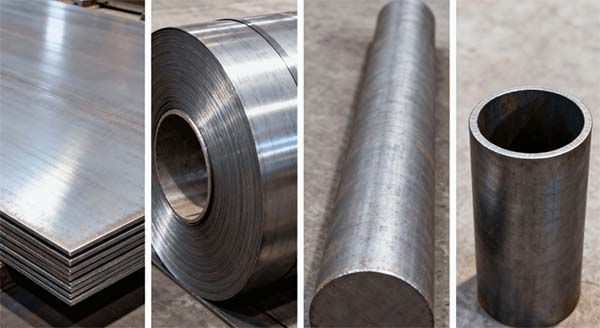
Structural steel grades S235, S275 y S355 are defined under the Norma EN 10025 y representan los materiales más utilizados en edificios, puentes, estructuras marítimas y maquinaria pesada.
This guide compares the 3 most common EN 10025 structural steel grades — S235, S275, and S355 — including yield strength, tensile strength, chemical composition, and international equivalents. It focuses on technical performance rather than procurement or cost.
S235, S275, and S355 Structural Steels Grades Overview
Grado
Mínimo límite elástico (MPa)
Typical Suffix
Prueba de impacto
S235
235
JR
Room temperature
S275
275
JR
Room temperature
S355
355
JR / J2 / NL
Room / Low temperature
El sistema de designación de la norma EN 10025 es sencillo:
La carta "S" significa acero estructural.
El número representa el límite elástico mínimo en N/mm².
Suffixes like JR, J2, NL indicate impact toughness requirements.
Mechanical Properties Comparison of S235, S275 and S355 Steel
Mechanical performance varies among S235/S275/S355 primarily in yield strength (ReH) and tensile strength (Rm). Yield strength is the primary classification basis under EN 10025, while tensile strength provides an additional reference for overall mechanical performance.
1. Yield Strength of S235, S275 and S355 (EN 10025)
According to EN 10025-2, the minimum yield strength (fy) of structural steel grades S235, S275, and S355 is defined as 235 MPa, 275 MPa, and 355 MPa respectively for plate thickness up to 16 mm. These values represent standard-specified minimums rather than guaranteed test results for every heat. As thickness increases, the minimum required yield strength decreases in stepwise ranges as specified in the standard.
This stepwise increase in fy explains the fundamental structural difference between S235, S275, and S355, with S355 preferred for heavy load-bearing or dynamically loaded structures, while S235 and S275 are more commonly used for light and medium structural applications.
2. Quick Comparison Table: S235 vs S275 vs S355 Mechanical Properties
The table below compares the key mechanical properties of S235, S275, and S355 structural steel, including yield strength (ReH), tensile strength (Rm), elongation, impact resistance, weldability, and formability.
Propiedad
S235
S275
S355
Límite elástico (MPa)
235
275
355
Resistencia a la tracción (MPa)
360-510
370-530
470-630
Alargamiento (%)
≥26
≥23
≥22
Resistencia a los impactos
Básico
Mejorado
Excelente, apto para bajas temperaturas
Soldabilidad
Excelente
Excelente
Bien
Formabilidad
Alta
Moderado
Baja
Composición química de S235, S275 y S355 (comparación de C y Mn)
La diferencia en el límite elástico procede principalmente del contenido de carbono y manganeso.
Grado
Carbono (C %)
Manganeso (Mn %)
Explicación
S235
≤0.17
≤1.40
Bajo contenido en carbono, excelente soldabilidad, menor resistencia
S275
≤0.21
≤1.50
Carbono y manganeso ligeramente superiores, propiedades equilibradas
S355
≤0.24
≤1.60
Mayores niveles de C y Mn, lo que se traduce en un mayor límite elástico
Engineers should note that while increasing C and Mn enhances límite elástico, it can slightly reduce weldability.
S235, S275 y S355Equivalentes materiales
Below is a simplified equivalence chart for S235, S275, and S355 steel:
Norma EN
Equivalente ASTM
Equivalente JIS
Equivalente GB
S235JR
ASTM A36
SS400
Q235B
S275JR
ASTM A36 / ASTM A529
SM400A / B
Q275
S355JR
ASTM A572
SM490A / B
Q345B
Key Technical Differences Between S235, S275 and S355 Steel
1.Strength: S355 > S275 > S235 in both yield and tensile strength
Cómo elegir entre los tipos de acero S235, S275 y S355
Tipo de proyecto
Grado recomendado
Razón
Estructura ligera, estructura de almacén
S235
Fácil fabricación, menor coste
Estructura comercial o puente
S275
Mayor capacidad de carga, coste moderado
Construcción en alta mar o en altura
S355
Alta resistencia, excelente tenacidad
When engineers compare structural grades such as S235, S275, and S355, environmental factors like wind load, vibration, and temperature conditions must be considered.
Preguntas frecuentes
Q: What is the yield strength of S235 steel according to EN 10025? A: According to EN 10025-2, the minimum yield strength of S235 structural steel is 235 MPa for plate thickness up to 16 mm. For thicker plates, the specified minimum yield strength decreases stepwise depending on thickness ranges defined in the standard.
Q: What is the yield strength of S275 steel in MPa? A: The minimum yield strength of S275 steel is 275 MPa for thickness up to 16 mm, as specified in EN 10025-2. For greater thicknesses, the minimum yield strength is reduced according to the standard’s thickness-dependent limits.
Q: What is the tensile strength of S275 steel? A: S275 typically offers 370–530 MPa tensile strength, depending on thickness.
Q: What are the chemical composition limits for these grades? A: The main variations involve carbon and manganese: S235 (lowest), S355 (highest), reflecting their strength differences.
Q: What are the ASTM, JIS, and GB equivalents for S355? A: ASTM A572 Grade 50, JIS SM490, and GB Q345B.
Q: What are the differences between S275 and S355? A: S355 has higher yield/tensile strength, better impact resistance, and is suitable for heavy-duty or cold-environment applications.
Q: Are S235, S275, and S355 weldable? A: Yes. All three grades are weldable; S235 is generally easiest to fabricate.
Q: Is S235 stainless steel? A: No. S235 is not stainless steel. It is a carbon structural steel grade defined in EN 10025. Stainless steels contain significant chromium content (usually above 10.5%), while S235 is a low-carbon structural steel mainly used for general construction and fabrication.
Conclusión
A la hora de elegir entre S235 / S275 / S355La elección de la mejor calidad depende de los requisitos de resistencia del proyecto, del presupuesto y del plazo de entrega.
S235 - Económico, fácil de fabricar.
S275 - Equilibrio entre rendimiento y coste.
S355 - Calidad superior para estructuras exigentes.
Las barras de acero al carbono son materiales resistentes y duraderos que se utilizan en la construcción, la industria manufacturera y la maquinaria para soportes estructurales y componentes.
Explore las propiedades y aplicaciones del acero para herramientas 4Cr3Mo3SiV. Encuentre placas de acero GB 4Cr3Mo3SiV, proveedores y fabricantes de matrices para trabajo en caliente y en frío.
Excellent article comparing S235, S275, and S355 structural steel grades! The breakdown of mechanical properties and applications is very helpful for engineers and procurement specialists.

2025-11-1601:05