 CJM Steel Group Ltd.

HSLA Steel Grades, Properties & Applications
4644Compare HSLA steel grades, properties, and strength levels. View grade charts and learn how HSLA steel plate is used in structural and industrial projects.
Ver detallesBuscar en toda la estación
Steel plate cost in international trade is not a fixed number per ton. Instead, it is the result of multiple cost layers, including raw material value, freight structure, order quantity, specifications, and compliance requirements.
For global buyers, EPC contractors, and distributors, understanding what affects steel plate cost is critical to controlling total procurement budget and optimizing sourcing decisions.
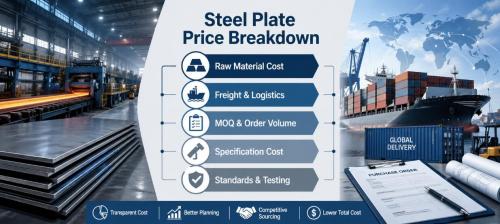
Before analyzing individual factors, it is important to understand that steel plate cost in export business is typically structured in layers:
In real procurement, buyers are not only paying for steel itself, but for the entire landed cost structure.
For a detailed breakdown of how these elements form the final quotation, you can refer to the carbon steel price per ton guide.
Freight is one of the most underestimated factors in steel plate cost, especially in international shipments.
Unlike high-value products, steel plates are heavy and bulk-loaded, which makes logistics a major part of total cost.
Standard containers have strict internal size limits, while steel plates are often produced in standard lengths close to those limits.
This creates common issues in export practice:
Both situations can increase handling complexity and overall steel plate cost per ton.
The choice between container shipping and bulk vessel shipment also impacts cost efficiency:
This is why the difference between FOB and CIF pricing structures can significantly change the final procurement cost.
Minimum Order Quantity (MOQ) directly affects steel plate cost efficiency because steel production is based on batch processing rather than individual orders.
Steel mills typically organize production in batches:
This leads to a key procurement outcome:
From a buyer’s perspective, combining multiple specifications into one shipment can significantly improve cost performance.
This is why experienced buyers focus not only on unit price, but also on order structure design.
Practical strategies for optimizing order structure are explained in the steel plate buying checklist.
Steel plate pricing is also affected by specification customization rather than raw steel value itself.
Key factors include:
Thickness does not directly change steel market value, but it affects production efficiency and processing cost. Standard sizes are more cost-efficient, while customized dimensions increase waste ratio and processing time.
Buyers often refer to steel plate size chart and weight table for structural applications to standardize procurement specifications and reduce unnecessary cost.
Many buyers assume that steel plate cost is only determined by material grade, but in reality, specification design plays a major role.
Factors that increase cost include:
Thickness itself does not change the base steel value, but it significantly affects:
A deeper explanation of how thickness affects pricing can be found in Why Thick Steel Plates Cost More.
Compliance requirements are a major cost driver in international projects.
Different standards increase steel plate cost due to stricter control and verification processes.
Typical requirements include:
Higher-spec projects may require:
Even when two materials are technically equivalent, differences in certification and inspection can lead to noticeable cost variation.
For buyers, the key is to balance engineering requirements and cost efficiency, rather than automatically choosing higher specifications.
As a global commodity, steel plate cost is also affected by external market factors:
This means that steel plate cost is dynamic, not fixed, and can change depending on timing and market conditions.
Comprender steel plate cost factors allows buyers to take control of procurement decisions.
1. Consolidate order volumes
Combining multiple specifications into one shipment improves MOQ efficiency and reduces unit cost.
2. Select appropriate Incoterms (FOB vs CIF)
FOB is suitable for buyers with logistics capability, while CIF simplifies procurement for end users.
3. Avoid over-specification
Unnecessary tight tolerances or excessive requirements increase cost without improving project performance.
4. Use flexible grade substitution when applicable
Engineering-approved equivalent grades can reduce procurement cost.
5. Plan sourcing strategy in advance
Align with production cycles and shipping schedules
For a complete sourcing workflow, see the import guide for steel plates from China.
Steel plate cost is not determined by a single factor, but by a combination of:
For professional buyers, the goal is not simply to find the lowest price, but to understand the full cost structure and optimize every component of the procurement process.
We support global buyers, distributors, and project contractors with:
👉 To receive an accurate quotation based on your requirements (grade, thickness, quantity, and destination port), contact us for a detailed cost breakdown.
Request a quotation → Get structured pricing within 24 hours.

Compare HSLA steel grades, properties, and strength levels. View grade charts and learn how HSLA steel plate is used in structural and industrial projects.
Ver detalles
Descubra cómo se utilizan las barras de refuerzo ASTM A615 en pilares, muros, cimientos, vigas, calzadas y encimeras de hormigón. Aprenda consejos de selección de grado para su proyecto.
Ver detalles
Compare C channel vs U channel steel in differences, sizes, strength, and applications. Learn the key differences and how to choose wisely for your project.
Ver detalles
Steel plate procurement checklist covering specifications, quality checks, supplier evaluation, costs, and delivery risks to avoid purchasing problems.
Ver detalles
HolaConéctese