I Beam vs H Beam is a common comparison when selecting structural steel sections for construction, fabrication, and industrial projects. Although these two steel beam types look similar, their cross-sectional design, manufacturing methods, strength characteristics, and applications are different.
Comprender la difference between I beam and H beam helps engineers, contractors, and steel buyers select the most suitable structural section based on load requirements, fabrication needs, and project conditions.
This guide explains the key differences between H beam vs I beam, including design, strength, applications, and selection considerations.
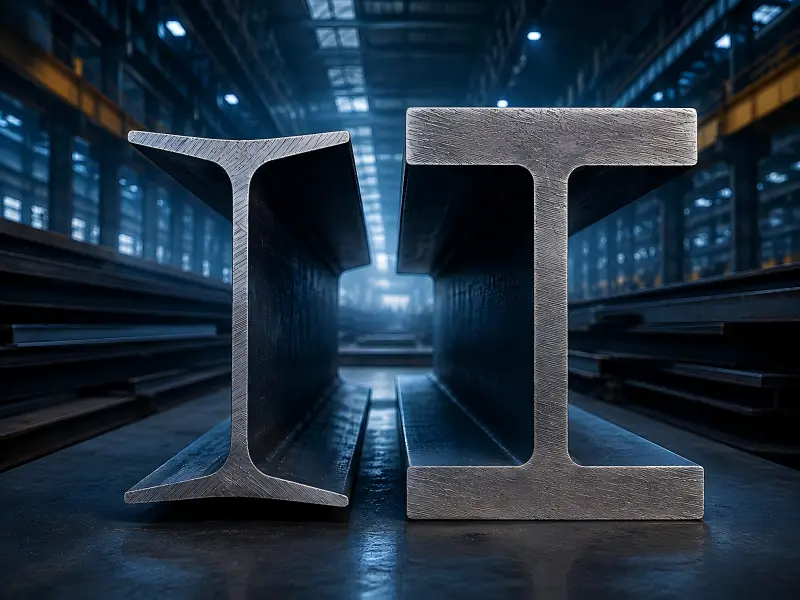
Traditional I beam with tapered inner flanges left vs modern H beam with wider parallel flanges right
H Beam vs I Beam: Key Differences and Comparison
Al comparar H beam vs I beam, the most important differences come from their geometry and manufacturing design.
Both sections consist of a vertical web and horizontal flanges. However, the relationship between flange width, flange thickness, and web design creates different structural characteristics.
Difference Between I Beam and H Beam: Flange Design
The most noticeable difference between I beam and H beam is the flange structure.
Traditional I beams usually have narrower flanges and may feature tapered inner flange surfaces. This design reduces material usage but provides less stability against lateral forces.
H beams generally have wider flanges with parallel flange surfaces. The wider flange design creates a more balanced cross-section, improving load distribution and structural stability.
Parallel Flanges vs Tapered Flanges
The flange profile is one of the key ways to distinguish an I beam from an H beam.
I beams: Traditional sections such as IPN or S-type beams often use tapered flange designs, where the inner flange surface has a slope. This can require special considerations during bolted connections and fabrication.
H beams: Wide flange H sections typically have parallel flange surfaces. The uniform flange thickness makes welding, cutting, and connection fabrication easier.
For steel fabricators and contractors, this difference affects not only structural performance but also processing efficiency.
Manufacturing Differences Between I Beams and H Beams
Another important I beam vs H beam difference is how large sections are produced. Most standard I beams are manufactured through hot rolling into fixed structural profiles.
H beams can be produced through:
hot rolling for standard sections
welded fabrication using three steel plates for large custom sections
The ability to manufacture welded H beams allows larger and heavier structural members to be produced for specialized projects.
I Beam vs H Beam Comparison Table
Característica
I Beam
H Beam
Cross-section
I-shaped profile
H-shaped profile
Flange design
Usually narrower, often tapered
Wider and generally parallel
Flange width
Smaller width-to-depth ratio
Larger width-to-depth ratio
Load distribution
Efficient for specific bending loads
Better overall load distribution
Lateral stability
Lower resistance to side buckling
Higher resistance to lateral movement
Fabricación
Standard rolled sections
Rolled or welded sections available
Common applications
Bridges, machinery, secondary structures
Buildings, industrial frames, heavy structures
H Beam vs I Beam Strength: Structural Performance Comparison
One of the most searched questions about H beam vs I beam strength is which structural section can handle higher loads. The answer depends on the application, but H beams generally provide better overall structural performance because of their wider flange design and larger cross-sectional area.
Moment of Inertia and Bending Resistance
En moment of inertia is an important engineering property that describes how effectively a structural section resists bending. A higher moment of inertia means the section can resist bending forces more efficiently and experience less deflection under the same loading condition.
Compared with traditional narrow-flange I beams, H beams typically provide:
higher moment of inertia around the weaker axis
improved resistance against lateral deformation
better performance in multi-directional loading conditions
Bending Performance
I beams are highly efficient when resisting bending forces along their primary axis. This makes them suitable for many applications where the loading direction is predictable. However, because H beams have wider flanges, they provide more balanced strength in different directions.
This makes H beams commonly selected for:
building columns
heavy steel frames
industrial structures
high-load applications
Torsional Resistance and Structural Stability
Another important factor in I beam vs H beam strength comparison is resistance to twisting. The wider flange design of H beams provides improved torsional resistance and better stability compared with narrow-flange sections.
For structures exposed to complex loading conditions, vibration, or heavy operational forces, H beams often provide a more suitable solution.
Structural Performance Comparison
Structural Factor
I Beam
H Beam
Flange width
Narrower
Wider
Moment of inertia
Strong in primary bending direction
Higher balance between axes
Resistance to lateral buckling
Moderado
Better
Torsional resistance
Baja
Más alto
Typical structural role
Secondary beams and supports
Primary load-bearing structures
I Beam vs H Beam Dimensions and Selection Considerations
Aunque I beams and H beams have different designs, selecting the right section depends on more than appearance.
Engineers normally consider:
required load capacity
span length
structural stability
connection requirements
fabrication method
For projects requiring detailed specifications and available beam options, you can refer to our H beam dimensions guide.
The selection of beam dimensions should always consider engineering requirements rather than size alone. Factors such as structural loads, building design, and application environment all influence the final choice.
I Beam Applications
I beams are widely used in applications where strength, efficiency, and material optimization are important.
Common I beam applications incluyen:
puentes
machinery structures
equipment supports
workshops
secondary structural frameworks
Because of their efficient design, I beams are often selected for projects that require reliable structural support without excessive material usage.
For customers looking for consistent supply of structural sections, CJM Steel provides I beam steel products for construction, fabrication, and industrial applications.
H Beam Applications
H beams are commonly used in heavy-duty construction because of their excellent stability and load-bearing performance.
Typical H beam applications incluyen:
edificios comerciales
warehouses
industrial plants
steel structures
large construction projects
Compared with many traditional steel beam sections, H beams provide stronger support for structures requiring high vertical loads and long service life.
Suministros de acero CJM H beam steel for global construction and industrial projects, with various standards and specifications available for different structural requirements.
I Beam vs H Beam: Which One Should You Choose?
Choosing between an I beam and an H beam depends on the specific project requirements.
Choose I Beam When:
the structure requires efficient bending performance
lower material weight is preferred
the load requirements are moderate
cost and material efficiency are important
Choose H Beam When:
higher load capacity is required
large structural frames are involved
better stability is needed
the project requires heavy-duty steel construction
For most large-scale construction projects, H beams are commonly selected because of their higher stability. However, I beams remain an excellent choice for many engineering and fabrication applications.
Buying I Beam and H Beam from a Reliable Supplier
Selecting the correct structural section is only one part of a successful steel project. Reliable supply, consistent quality, and suitable specifications are equally important.
A professional structural steel supplier can support customers with:
suitable steel grades
calidad constante
required specifications
export experience
stable delivery
FAQ: I Beam vs H Beam
What is the difference between I beam and H beam?
The main difference between I beam and H beam is their flange design and structural performance. I beams have narrower flanges and are generally lighter, while H beams have wider flanges and provide better load distribution for heavy structures.
Why is an H beam stronger than an I beam?
An H beam is often stronger in heavy-load applications because its wider flange design provides a larger cross-sectional area, higher moment of inertia, and improved resistance to lateral buckling.
Can an I beam be replaced by an H beam?
In many cases, an H beam can replace an I beam when higher load capacity or stability is required. However, H beams are usually heavier and may increase material costs, so replacement decisions should be based on structural calculations.
How can you identify an I beam and an H beam?
The easiest way is to examine the flange shape. Traditional I beams often have tapered inner flange surfaces, while H beams usually have parallel flange surfaces with a more balanced rectangular profile.
Which beam is better for building construction?
For most large building structures, H beams are commonly preferred because of their higher stability and load-bearing capability. However, the appropriate choice depends on engineering design, structural loads, and project requirements.
Descubra las mejores placas de acero NM400, NM450 y NM500 resistentes al desgaste para equipos de minería y canteras. Mejore la durabilidad y reduzca el tiempo de inactividad con CJM Steel.
Calcule en línea el peso de las bobinas de acero. Admite bobinas laminadas en caliente y en frío, galvanizadas, inoxidables y de aluminio. Introduzca el diámetro exterior, el diámetro interior y la anchura para obtener un resultado rápido.
 CJM Steel Group Ltd.



HolaConéctese