C channel and U channel steel are two common types of structural steel channel sections used in construction, fabrication, machinery, and industrial projects. Although both profiles are open channel sections, differences in their cross-sectional design, manufacturing method, flange structure, and load performance make them suitable for different applications.
Understanding the difference between C channel vs U channel helps engineers, contractors, and buyers select the right steel channel based on structural requirements, fabrication needs, and project conditions.
In commercial steel markets, C channels are often associated with cold-formed C purlins, which may include edge stiffeners or inward-bent lips to improve section efficiency. U channels usually refer to open structural channels such as UPN or UPE sections, which are commonly produced through hot rolling and used for heavier structural applications.
Esta guía compara C channel and U channel steel in terms of profile design, sizes, strength, applications, and how to choose the suitable option for your project.
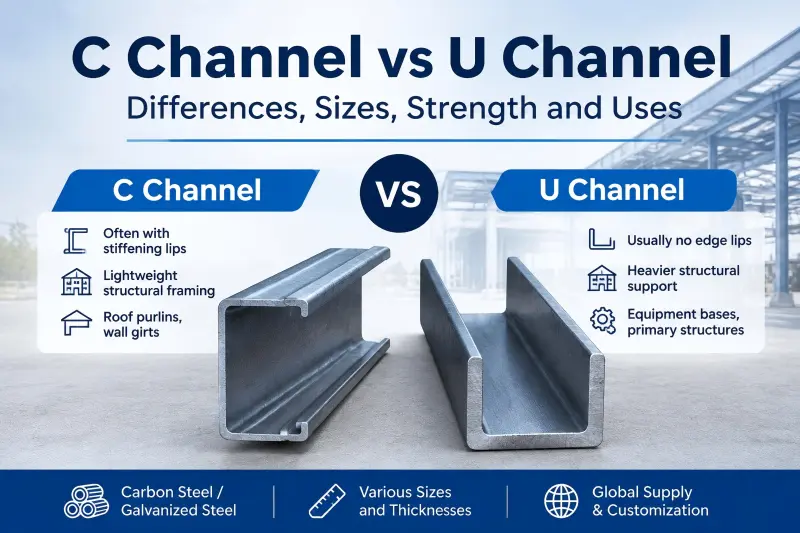
Comparison of C channel and U channel steel showing differences in section design strength characteristics and typical applications
C Channel vs U Channel: Key Differences
The main difference between C channel and U channel is related to their section design, flange configuration, and typical manufacturing process.
Unlike a simple visual comparison, professional steel selection depends on factors such as edge design, flange type, structural efficiency, and resistance to buckling.
C channels, especially cold-formed C purlins, often feature inward-bent stiffening lips at the flange edges. These lips improve local stability and increase resistance against buckling, making them widely used in secondary steel framing systems such as roof purlins and wall girts.
U channels, including common UPN and UPE structural channels, generally have open flanges without edge lips. Depending on the standard, they may feature tapered flanges or parallel flanges, making them suitable for different structural and fabrication requirements.
Característica
Canal C
Canal U
Typical Section Type
Cold-formed C purlins or C sections
Hot-rolled UPN/UPE or open structural channels
Edge Design
Often includes inward stiffening lips
Usually no edge lips
Proceso de fabricación
Cold roll forming from steel coils
Hot rolling from steel billets
Flange Design
Usually designed for lightweight structural efficiency
Tapered flange or parallel flange depending on standard
Buckling Resistance
Stiffening lips improve local buckling resistance
Higher sectional mass provides overall rigidity
Usos comunes
Roof purlins, wall girts, light steel structures
Heavy structures, frames, equipment supports
When selecting between C channel vs U channel steel, buyers should consider the complete section properties rather than profile appearance alone.
C Channel vs U Channel Size Comparison
Ambos C channel and U channel steel are available in different heights, widths, thicknesses, and lengths to meet various project requirements.
Al comparar c channel vs u channel sizes, buyers usually consider:
Channel height
Flange width
Web thickness
Overall section weight
Required load capacity
The correct channel size should be selected according to structural calculations, span length, load conditions, and connection requirements.
For detailed size information, C channel dimensions and standard size ranges can be reviewed in our guide to steel C channel sizes chart, while U channel specifications and common dimensions are covered in our U channel steel sizes guide.
Different projects may require different combinations of size and thickness. Heavy structural applications usually require larger sections with greater thickness, while lightweight fabrication projects may use smaller channel sections.
C Channel vs U Channel Strength Comparison
Strength is one of the most important factors when choosing between C channel vs U channel steel.
From an engineering perspective, channel performance is influenced by section modulus, moment of inertia, flange design, material strength, and resistance to buckling.
Generally, cold-formed C channels with stiffening lips provide a high strength-to-weight ratio and improved resistance to local deformation, making them effective for roof purlins, wall framing, and secondary structural systems.
However, hot-rolled U channels such as UPN or UPE sections usually provide higher sectional mass and overall rigidity, making them suitable for heavier structural applications, equipment supports, and primary framing systems.
The actual strength of a channel section depends on multiple factors, including:
Calidad del acero
Channel dimensions
Espesor
Load direction
Support conditions
Fabrication method
Therefore, when comparing c channel vs u channel strength, the better choice depends on the project design and required structural performance rather than the channel shape alone.
C Channel vs U Channel Applications
The applications of C channel and U channel steel overlap in some areas, but each profile has advantages in specific situations.
C Channel Applications
C channels are widely used in structural and industrial applications, including:
Building frames
Roof purlins
Wall girts
Steel structures
Bastidores de maquinaria
Equipment supports
Light steel construction
Because of their efficient section design and high strength-to-weight ratio, C channels are commonly selected for projects requiring lightweight but reliable structural support.
U Channel Applications
U channels are commonly used for:
Heavy structural frames
Bases de equipos
Steel fabrication
Support structures
Architectural applications
General manufacturing projects
Their hot-rolled structure and available heavy sections make U channels suitable for applications requiring higher rigidity and load-bearing capability.
C Channel vs U Channel: Which One Should You Choose?
Elegir entre C channel vs U channel depends mainly on the purpose of the project.
Choose C Channel When:
Higher strength-to-weight efficiency is required
Lightweight structural framing is needed
Roof purlins or wall girts are involved
Better local buckling resistance is required
Choose U Channel When:
Heavy structural support is required
Higher sectional rigidity is needed
Equipment bases or primary structures are involved
Hot-rolled structural sections are preferred
For construction and industrial projects, buyers should consider not only the channel shape but also steel grade, thickness, dimensions, manufacturing standard, and supplier capability.
Steel Channel Material and Supply Options
C channels and U channels are commonly manufactured from carbon steel, galvanized steel, and other structural steel grades depending on environmental conditions and project requirements. Depending on project requirements, steel channels can be supplied according to different international standards, including ASTM, EN, and JIS specifications.
Suministros de acero CJM C channel steel y U channel steel in different sizes, thicknesses, and specifications for construction, manufacturing, and industrial applications. Our steel channels support customized requirements and export projects worldwide.
Factors to Consider When Buying C Channel or U Channel
Before purchasing steel channel sections, buyers should evaluate the following factors:
Grado de acero
The steel grade affects strength, durability, and application suitability. Different projects may require specific standards such as ASTM A36, ASTM A572, EN, or JIS grades.
Dimensions and Thickness
Channel height, flange width, and thickness directly influence section modulus, load capacity, and structural performance.
Tratamiento de superficies
For applications requiring corrosion resistance, galvanized steel channels may provide longer service life compared with untreated carbon steel.
Supplier Capability
A reliable steel channel supplier should provide consistent quality, accurate dimensions, inspection documents, and stable delivery for project requirements.
Preguntas frecuentes
Is C channel stronger than U channel?
It depends on the application and load requirements. C channels with stiffening lips provide good strength-to-weight performance, while hot-rolled U channels offer higher rigidity for heavy structural applications.
What is the difference between C channel and U channel?
The main difference is their section design, flange structure, and typical applications. C channels are often used for lightweight structural framing, while U channels are commonly selected for heavier support structures.
Are C channel and U channel available in different sizes?
Yes. Both C channel and U channel steel are available in various sizes, thicknesses, and standards. The suitable size depends on load requirements, structural design, and fabrication needs.
Which steel channel is better for construction projects?
There is no universal choice. C channels are often preferred for purlins and light steel structures, while U channels are suitable for applications requiring higher rigidity and load capacity.
Conclusión
C channel and U channel steel are both widely used structural steel sections, but their different designs make them suitable for different applications.
C channels, especially cold-formed sections with stiffening lips, are commonly selected for lightweight structural systems, roof purlins, and applications requiring high strength-to-weight efficiency. U channels, including UPN and UPE hot-rolled sections, are commonly used for heavier structures requiring greater rigidity and load capacity.
By comparing channel design, flange structure, size requirements, strength characteristics, and applications, buyers can select the right steel channel solution for their projects.
El alambre de acero al carbono es un material muy utilizado en diversas industrias por su resistencia, durabilidad y rentabilidad. Es común encontrarlo en aplicaciones que van desde la automoción a la construcción, ofreciendo un excelente equilibrio de rendimient...
Standard steel plate thickness chart from 1/4” to 12”, including inch-to-mm conversion and weight reference. Quick lookup table for engineering and fabrication projects.
Explore galvanized wall panels, GI roofing sheets, and steel plates for container houses and modular buildings. Learn how to choose properly for your projects.
 CJM Steel Group Ltd.



HolaConéctese