Custom cutting can make steel plates easier to use in fabrication and construction projects, but it also affects the final material cost. The total cost depends on more than the steel price per ton. Plate thickness, steel grade, cutting length, number of cuts, cutting method, tolerance, order quantity, and material utilization can all affect the final quotation.
CJM Steel supplies cut-to-size chapas de acero al carbono for construction, fabrication, machinery, and industrial projects. We support custom dimensions, project-based cutting requirements, mill test certification, and export delivery.
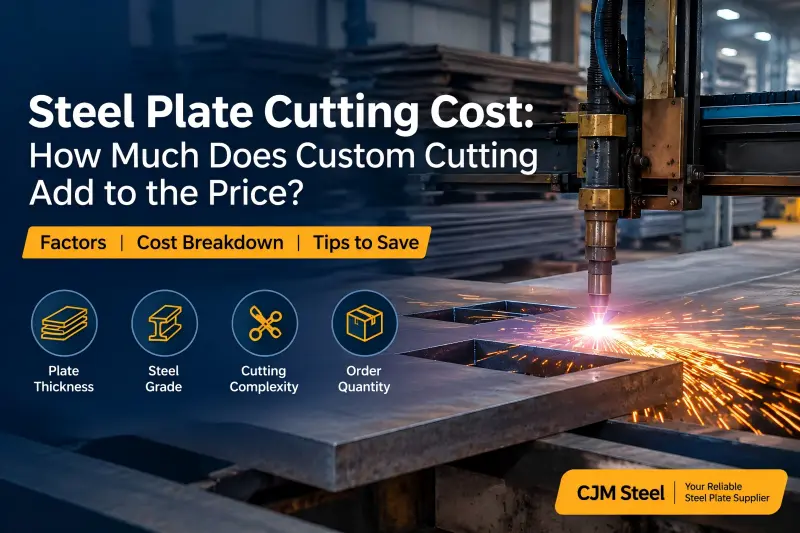
Steel plate cutting cost depends on thickness cutting method complexity and order quantity
What Is Included in Steel Plate Cutting Cost?
When comparing a standard steel plate with a cut-to-size plate, buyers should consider the complete processing cost rather than looking only at the cutting charge.
The total cost of a custom-cut steel plate may include:
Steel plate material cost
Cutting and processing cost
Additional machining or edge preparation
Packaging and handling
Delivery or export shipping
For this reason, a supplier may quote a cut-to-size plate at a higher unit price than a standard plate even when the underlying steel grade and thickness are the same.
The important question is not simply “How much does steel cutting cost?” but rather “What is the total cost of obtaining the finished steel plate I need?”
What Factors Affect Steel Plate Cutting Cost?
1. Steel Plate Thickness
Thickness is one of the main factors affecting cutting cost.
Thicker steel plates generally require more cutting time, higher energy input, and equipment suitable for heavy plate processing. The relationship between thickness and cost is not necessarily a fixed price per ton because cutting speed and processing requirements can change with thickness.
Before comparing cutting costs, buyers should confirm the required steel plate thickness and consider whether a standard thickness can meet the project requirements.
For example, cutting a simple profile from a medium-thickness carbon steel plate may require considerably less processing than cutting the same profile from a very thick plate.
2. Steel Grade
The steel grade can also affect the cutting process and quotation.
Common structural grades such as A36, S235, and S355 are generally straightforward to process. Higher-strength, abrasion-resistant, pressure-vessel, or other specialty grades may require different processing parameters or additional controls.
For example, buyers working with A36 can review the specifications and dimensions of Placa de acero ASTM A36 before requesting a custom-cut quotation.
The material grade itself does not automatically determine the cutting price. Instead, suppliers consider how the grade, thickness, required tolerances, and cutting method work together.
3. Cutting Length and Number of Cuts
The amount of cutting required is another major cost factor.
A rectangular plate that requires only a few straight cuts is much simpler to process than a plate that must be divided into many individual components.
For example, an order may require:
Four straight cuts to produce several rectangular plates
Multiple profile cuts for fabricated components
Numerous openings or internal contours
Repeated parts cut from the same plate
The longer the total cutting path and the greater the number of operations, the more processing time may be required.
4. Shape and Cutting Complexity
Simple rectangular or square pieces are generally easier to cut than complex profiles.
Custom shapes may require:
CNC programming
Multiple cutting paths
Internal openings
Curved or irregular contours
Additional positioning and handling
If the buyer provides a CAD drawing or detailed cutting diagram, the supplier can usually evaluate the required processing more accurately.
5. Cutting Tolerance and Edge Requirements
Not every project requires the same dimensional accuracy or edge condition.
Standard fabrication work may accept normal cutting tolerances, while precision components may require tighter dimensional control or additional edge preparation.
Requirements such as:
Tight dimensional tolerance
Beveled edges
Special edge preparation
Specific surface or edge quality
can increase processing requirements and therefore affect the quotation.
6. Order Quantity
Order quantity can have a significant effect on the unit cutting cost.
A small order may require setup, programming, handling, and material preparation that cannot be spread across many pieces. With larger orders containing repeated dimensions, these setup costs can be distributed across more pieces.
As a result, buyers should compare the total order cost, rather than assuming that a supplier’s cutting charge will always be the same per piece.
7. Material Utilization and Scrap
Material utilization is often overlooked when comparing steel cutting costs.
Suppose a standard plate is large enough to produce the required components but leaves a substantial amount of unused material. The cutting itself may be inexpensive, but the project can still have a higher effective material cost because of scrap.
Good cutting plans can improve material utilization by arranging multiple parts efficiently on the available plate area.
Before calculating the material requirement for a custom-cut order, buyers can also use a calculadora de peso de chapa de acero to estimate the base material weight.
For larger projects, optimizing the cutting layout can sometimes reduce total material consumption more effectively than simply negotiating a lower cutting charge.
How Much Does Steel Plate Cutting Add to the Price?
There is no universal steel plate cutting cost per ton o steel plate cutting cost per piece that applies to every order.
Suppliers normally calculate the quotation according to the actual processing requirements.
A simplified cost structure is:
Total cut-to-size cost = Steel plate cost + Cutting cost + Additional processing + Packaging and delivery
For example, a buyer ordering A36 steel plate may need:
A specific thickness
Several custom dimensions
Plasma or oxy-fuel cutting
Standard dimensional tolerance
Embalaje para exportación
Delivery to a specified destination
The final quotation needs to account for all of these requirements.
This is why two orders using the same steel grade and thickness can have different cutting costs.
Cost per Ton vs. Cost per Piece
For bulk steel orders, buyers may compare the overall processing cost against the total tonnage.
For smaller or highly customized orders, the cost per finished piece can be more useful.
The quotation may therefore be influenced by:
Total steel weight
Number of pieces
Total cutting length
Cutting complexity
Setup requirements
Quantity of repeated parts
When comparing quotations from different steel suppliers, make sure the quoted prices are based on the same specifications and processing requirements.
Plasma vs. Oxy-Fuel vs. Laser Cutting: Which Costs Less?
Different cutting methods are suitable for different steel plate specifications.
Cutting Method
Aplicación típica
Cost Consideration
Plasma cutting
Medium and thicker steel plates, profiles
Good balance of speed and processing cost
Oxy-fuel cutting
Thick carbon steel plates
Suitable for heavy plate cutting
Laser cutting
Thin to medium plate and precision parts
High precision but equipment-intensive
Waterjet cutting
Precision or heat-sensitive applications
Generally higher processing cost
There is no single cutting method that is cheapest for every order.
For thick carbon steel plate, oxy-fuel cutting can be practical for large or heavy sections. Plasma cutting can provide a good balance for many general fabrication requirements, while laser cutting is more suitable when tighter precision and thinner material are required.
The most cost-effective method depends on plate thickness, material grade, shape, tolerance, quantity, and required edge quality.
Custom Cutting vs. Standard Steel Plate: Which Is More Cost-Effective?
Buying standard-size steel plate may appear cheaper because it avoids a supplier’s cutting charge. However, the lowest material price does not always mean the lowest total project cost.
Standard-Size Steel Plate
Ventajas:
Lower processing requirements
Potentially faster availability
More straightforward handling
Suitable when standard dimensions match the project
Potential disadvantages:
Additional cutting may be required at the fabrication site
More handling and processing
Greater potential for material waste
Additional local labor and equipment costs
Cut-to-Size Steel Plate
Ventajas:
Ready for fabrication or installation
Less onsite cutting
Better control of material utilization
Reduced handling for some projects
Easier integration with project drawings
Potential disadvantages:
Additional supplier processing cost
Processing lead time
More detailed specifications may be required
For projects involving many identical components or complex cutting requirements, supplier-side cutting can sometimes reduce the overall project cost even when the material quotation is higher.
How to Reduce Steel Plate Cutting Costs
Buyers can often reduce the total cost of custom-cut steel plates without sacrificing the required specifications.
Use Standard Dimensions Where Practical
If the project allows standard plate dimensions, unnecessary cutting can be avoided.
Optimize the Cutting Layout
A well-planned nesting layout can reduce scrap and improve material utilization.
Group Similar Cutting Requirements
Ordering multiple pieces with the same dimensions can reduce setup and programming requirements per piece.
Avoid Unnecessarily Tight Tolerances
Specify only the tolerance required for the application. Excessively tight requirements can increase processing costs.
Combine Cutting With the Steel Order
Having the steel supplier provide both the material and cutting service can reduce additional handling, transportation, and processing between different suppliers.
The goal should be to minimize the total project cost, rather than simply finding the lowest cutting charge.
What to Include When Requesting a Steel Plate Cutting Quote
A supplier can provide a more accurate quotation when the cutting requirements are clearly defined.
Include:
Calidad del acero
Plate thickness
Original plate dimensions, if known
Finished dimensions
Quantity
Cutting drawing or CAD file
Cutting tolerance
Edge requirements
Cutting method, if specified
Required delivery location
Requisitos de certificación
For example, instead of requesting:
“Please quote 20 tons of A36 steel plate with cutting.”
provide the finished dimensions and quantity of each part whenever possible.
A detailed cutting list allows the supplier to evaluate material utilization, cutting time, processing requirements, and delivery more accurately.
Cut-to-Size Steel Plate Supply from CJM Steel
Suministros de acero CJM chapas de acero al carbono for construction, fabrication, machinery manufacturing, and industrial projects, with custom cutting available according to project requirements.
Our supply support can include:
Carbon and structural steel plates
ASTM, EN, and JIS grades
Custom cut-to-size dimensions
Profile and plate cutting according to drawings
Mill Test Certificates (MTC)
Export-ready packing
Bulk and project-based orders
For a cutting quotation, send us the steel grade, thickness, finished dimensions, quantity, and drawing if available. We can evaluate the material and processing requirements based on your project specifications.
Preguntas frecuentes
Does custom cutting increase the price of steel plates?
Yes. Custom cutting adds processing costs, but the actual increase depends on thickness, cutting length, complexity, quantity, tolerance, and the cutting method.
How is steel plate cutting cost calculated?
Suppliers typically consider the required cutting operations, total cutting length, material thickness, quantity, setup requirements, and any additional processing.
Is it cheaper to buy standard-size steel plates or cut-to-size plates?
It depends on the project. Standard plates may have a lower purchase price, while cut-to-size plates can reduce onsite labor, handling, and material waste.
What information is needed for a steel plate cutting quotation?
The most useful information includes steel grade, thickness, finished dimensions, quantity, cutting drawing, tolerance, edge requirements, and delivery destination.
Can steel plate suppliers provide custom cutting?
Yes. Many steel suppliers can provide cut-to-size plates and profile cutting. The available cutting methods and maximum dimensions depend on the supplier’s processing capabilities.
Descubra los grados, tipos y normas mundiales del acero estructural. Compare A36, S235JR, S355, A572, A588 y más. Consejos prácticos para compradores internacionales.
Comprenda las principales diferencias entre el acero al carbono y el acero aleado. Compare la resistencia, el coste y los mejores casos de uso. Consejos de compra de expertos de CJM.
Explore galvanized steel properties including yield strength, tensile strength, hardness, coating specs, and grades for construction and industrial use.
Compare AR500 vs AR550 vs AR600 steel in hardness, wear resistance, price, and use. Learn how to choose the right abrasion resistant steel for your project.
 CJM Steel Group Ltd.



HolaConéctese