Checker plates, also known as diamond plates or tread plates, are widely used for stair treads, staircases, stair nosing, flooring, ramps, and walkways. Their raised surface pattern provides additional traction for areas where slip resistance and durability are important.
Para checker plate stair treads, the key selection factors are plate thickness, tread dimensions, material, pattern, support conditions, and whether the stairs are used indoors or outdoors.
This guide explains common checker plate stair tread, bordillo de escalera, and flooring applications, with practical thickness ranges and material considerations.
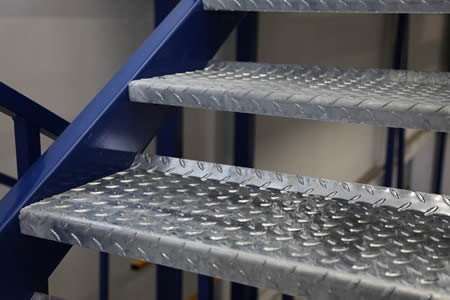
Peldaños de chapa de acero
1. Checker Plate Stair Treads
Checker plate stair treads are commonly used on industrial stairs, warehouse stairs, maintenance platforms, commercial buildings, and other access structures where a raised surface can provide additional traction.
Typical Thickness for Stair Treads
The required thickness depends on stair width, support spacing, expected load, and the structural design of the stair system.
Stair Application
Typical Plate Thickness
Light-duty pedestrian stairs
3–4 mm
Standard industrial stair treads
4–5 mm
Heavy-duty or high-traffic stairs
5–6 mm or as required
For many standard pedestrian applications, 3–4 mm checker plate can be used when the tread has adequate structural support. Industrial stairs with greater loading or wider unsupported spans may require thicker plate.
Common materials include A36, Q235B, SS400, and S235JR carbon steelen función de las necesidades del proyecto.
What to Consider for Stair Treads
When selecting a stair tread plateConsidéralo:
Tread width and length
Plate thickness
Support spacing beneath the tread
Expected pedestrian or equipment load
Indoor or outdoor exposure
Checker plate pattern
Edge and nosing configuration
The raised pattern improves surface traction, but it does not replace proper structural design or adequate support.
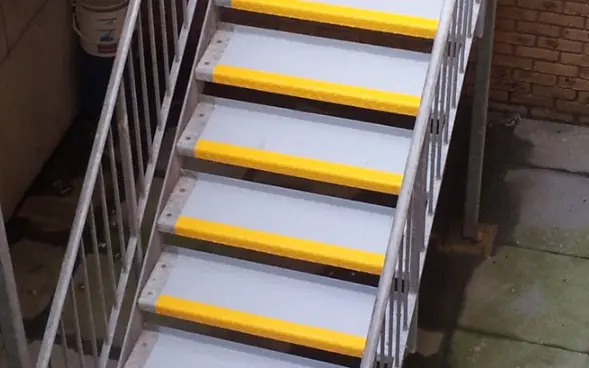
Cantoneras de escalera
2. Checker Plate Stair Nosing
Checker plate stair nosing is used along the front edge of a stair tread to improve edge visibility, provide additional traction, and protect the stair edge from wear.
For industrial and commercial stairs, checker plate nosing is commonly fabricated from the same or a compatible material as the stair tread.
Typical Stair Nosing Sizes
For most industrial and commercial stairs, stair nosing is fabricated by bending checker plate into an L-shape. Common sizes include:
• 30–50 mm horizontal tread coverage • 20–40 mm vertical drop on the step edge
These dimensions provide sufficient edge protection while maintaining comfortable foot clearance.
Recommended Nosing Thickness
For stair nosing applications, the most commonly used thickness is:
• 3–4 mm for standard pedestrian stairs • 4–5 mm for industrial or high-traffic stairs
Diamond pattern and 5-bar tread plates are typically preferred because the raised pattern improves traction at the step edge.
Checker Plate Stair Treads vs. Stair Nosing
Although both components are used on steel stairs, they serve different functions.
Component
Main Function
Common Considerations
Checker plate stair tread
Provides the walking surface
Thickness, tread size, support, load
Stair nosing
Protects and defines the front edge
Edge coverage, thickness, visibility
Stair tread plate
General term for the plate forming the step
Material, dimensions, structural support
Using compatible tread and nosing dimensions helps create a consistent stair system while maintaining the required walking surface and edge protection.
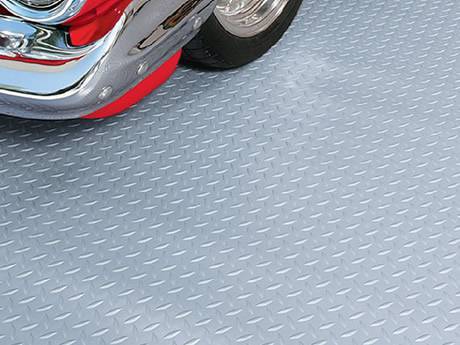
Suelos de chapa de damero para garajes
3. Checker Plates for Flooring
Checker plates are also used for industrial flooring, garage floors, platforms, and high-traffic walkways where a durable textured surface is required.
Las aplicaciones típicas son:
Suelos de garaje
Workshop floors
Industrial platforms
Warehouse walkways
Equipment access areas
For flooring, thickness should be selected according to support spacing and expected loads rather than application name alone.
Typical starting ranges include:
4.5–6 mm for many garage and general-duty flooring applications
5–8 mm for heavier industrial flooring
Thicker plate where heavier loads or wider unsupported spans require it
Diamond and raised-bar patterns are commonly selected for flooring because they provide a textured walking surface.
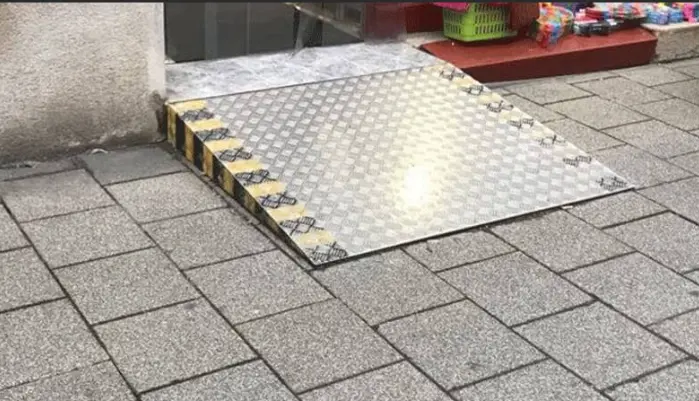
Placa de control para rampas
4. Checker Plates for Outdoor Use
Checker plates are widely used for ramps, outdoor stairs, loading areas, access platforms, and driveways where the surface may be exposed to rain, moisture, or vehicle traffic.
For outdoor applications, the selection should consider both mechanical requirements and corrosion protection.
Common Options
Carbon steel checker plate for painted or protected structures
Hot-dip galvanized checker plate for improved corrosion resistance
Thicker checker plate for vehicle or heavy-duty applications
For outdoor vehicle ramps or similar heavy-duty applications, 6 mm or thicker plate may be used depending on the support structure and load requirements.
5. Recommended Checker Plate Thickness Guide by Application
Proporcionar una orientación clara sobre el espesor ayuda a los clientes a elegir la chapa adecuada para su aplicación específica. A continuación encontrará una referencia práctica:
Escenario de aplicación
Espesor recomendado (mm)
Material recomendado
Peldaños de escaleras de interior
3-4
Acero al carbono / Aluminio
Peldaños industriales
4-6
Acero al carbono
Suelos de garaje
4.5-6
Acero al carbono
Rampas de acceso / exteriores
≥6
Acero galvanizado en caliente
Almacén y suelo industrial
5-8
Acero al carbono de alta resistencia
Nota: El peso por metro cuadrado varía en función del grosor y del tipo de dibujo. Los motivos en relieve suelen añadir 3-5% más peso que las placas planas.
6. Elegir el patrón adecuado
Los patrones no son sólo estéticos; también afectan a la seguridad:
Q1. What thickness is checker plate for stair treads?
A typical range is 3–5 mm for many pedestrian and standard stair applications. Industrial or heavy-duty stairs may require 4–6 mm or more, depending on support spacing and loading.
Q2. What is the best checker plate for stair treads?
Diamond and 5-bar checker plates are commonly used for peldaños because their raised patterns provide additional traction. The appropriate material and thickness depend on the stair structure and application.
Q3. Can checker plate be used for stair nosing?
Yes. Checker plate can be fabricated into bordillo de escalera to provide additional traction and protect the leading edge of the stair tread.
Q4. What thickness is checker plate for flooring?
Common flooring applications use approximately 4.5–8 mm checker plate, depending on the expected load, support spacing, and floor structure.
Q5. Is checker plate suitable for outdoor stairs?
Yes. For outdoor stairs exposed to moisture, galvanized checker plate or another corrosion-protected surface can help improve service life.
Q6. Is checker plate suitable for ramps?
Yes. Checker plate is commonly used for pedestrian and vehicle ramps because the raised surface provides additional traction. Thickness should be selected according to the ramp span, support, and expected load.
8. Checker Plates for Stair Treads Supply
For construction projects, industrial facilities, and equipment platforms, checker plates are commonly supplied as stair tread plates or cut-to-size stair components.
CJM Steel supplies export-ready chapas de acero a cuadros suitable for stair treads, stair nosing, and anti-slip flooring applications.
Available options include:
• Carbon steel checker plates • Hot-dip galvanized anti-slip plates for outdoor stairs • Custom cut stair treads and stair nosing pieces • Thickness range from 3 mm to 8 mm
Typical applications include industrial stairs, maintenance platforms, equipment access ladders, and warehouse walkways where reliable traction and structural durability are required.
Custom sizes, mill certificates, and export packing are available for international projects and distributors.
9. Conclusion and Next Steps
Placas de control son materiales versátiles que proporcionan superficies antideslizantes, durabilidad y atractivo estético para escaleras, garajes, talleres, entradas de vehículos y aplicaciones exteriores. Elegir el producto material, grosor y dibujo garantiza la seguridad y la longevidad al tiempo que cumple los requisitos presupuestarios y funcionales.
Póngase en contacto con nosotros para obtener información sobre tamaños personalizados, tablas de pesos y consultas sobre exportación para encontrar la solución de chapa estriada perfecta para su proyecto.
Guía completa sobre la chapa de acero ASTM A514: resistencia, dureza, soldadura, maquinabilidad, composición química y grados equivalentes para sus proyectos.
Explore las mejores chapas de acero para oleoductos y gasoductos y tanques de almacenamiento. Infórmese sobre API 5L, A516, A387 y mucho más para sus necesidades de alta presión.
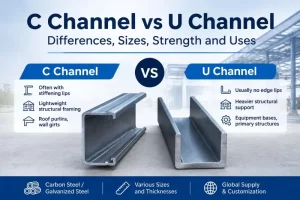
Compare C channel vs U channel steel in differences, sizes, strength, and applications. Learn the key differences and how to choose wisely for your project.
I am looking for a stair lip angle plate 5 X 4 inches, 4 mm thick, checkered stainless steel plate, 60 inches long, as protective corner and anti-slip surface on a concrete passageway. Remi Laforest, Tel. 450-655-8931
 CJM Steel Group Ltd.



I am looking for a stair lip angle plate 5 X 4 inches, 4 mm thick, checkered stainless steel plate, 60 inches long, as protective corner and anti-slip surface on a concrete passageway. Remi Laforest, Tel. 450-655-8931
2026-09-2217:15
Thanks for your inquiry. Our sales will reach out to you soon.
2026-09-2217:22